A Bad ASJ Paper on Breast Implant Illness Is Being Misused — Here's the Real Story
They claim biofilm causes BII because 39% of women with BII have a biofilm — but they don't tell you that women without BII have biofilms at the same rate. If the cause is equally common in healthy people, it isn't the cause. That isn't science. That's marketing.
A Bad Paper About BII Got Through Peer Review — Let's Break It Down
I've had this paper sent to me about a hundred times in the last week. It was published in ASJ (the Aesthetic Surgery Journal) and it's being used by explant influencers and breast implant illness (BII) "experts" to make claims that aren't actually supported by the evidence the paper itself analyzes.
This is a great example of why you really have to understand a subject matter before you can interpret research — and why even some papers that make it into peer-reviewed journals don't actually hold up under scrutiny.
I want to walk through the specific issues, because the conclusions of this paper are now being used to convince patients of things that aren't true and to drive them toward more invasive surgeries they don't need.
What Kind of Paper This Is
The paper is a meta-analysis — meaning the authors looked at the existing literature on a topic and pooled the results. They ended up analyzing 33 papers, of which only 7 were prospective studies.
That alone is a problem. Prospective studies (where you set up the design before you collect data) are much higher quality than retrospective studies (where you go back and analyze data after the fact). When the majority of your "evidence" is retrospective, your conclusions are inherently shaky.
So before we even get to the specific claims, the quality of the underlying evidence is poor. A meta-analysis can't produce strong conclusions from weak underlying studies — it just averages the weakness.
Claim 1: "Biofilm Is a Causative Agent for BII"
The paper claims that biofilm is causally linked to breast implant illness, citing that 39% of women with BII have a biofilm on their implant.
Why This Doesn't Hold Up
Here's what they didn't mention:
- Women without BII also have biofilm on their implants at the same rate
If 39% of women with BII have biofilm and 39% of women without BII also have biofilm, biofilm cannot be the cause of BII. That's basic epidemiology — to establish causation, the rate of the proposed cause has to be higher in the affected group than the unaffected group.
There's also a much more practical test: if biofilm caused BII, then patients who get their implants removed should only feel better if they had biofilm. They don't. In the data we have, patients who feel better after explant improve at the same rates whether or not they had biofilm. This finding has been repeated in the literature.
So there is no evidence biofilm is a causative agent for BII. Asserting that it is — and using that assertion to sell aggressive surgical interventions — isn't science. It's marketing.
Claim 2: "There's an Autoimmune Reaction to Implants Causing BII"
The paper also claims an autoimmune mechanism is responsible for BII. Their evidence:
Cited Evidence A: Elevated ANA
The paper cites ANA (antinuclear antibody) levels being elevated in BII patients.
Problem: ANA is elevated in approximately the same rate in the general population as it is in BII patients. Mild ANA elevations are common, non-specific, and seen in many people with no autoimmune symptoms at all.
If your "evidence" of autoimmunity is something that's present at the same rate in healthy people, that's not evidence of autoimmunity.
Cited Evidence B: Elevated Interleukins
The paper also cites one of the ACERB trials where several interleukins were elevated in the BII cohort.
Problem: The ACERB trial cohort had significant confounders in the BII group — meaning other variables that could independently account for the interleukin elevations. The original trial authors acknowledged this. The meta-analysis didn't.
You can't take a finding from a trial with confounders, strip out the discussion of those confounders, and present it as clean evidence of autoimmunity. That's misrepresenting the source paper.
Claim 3: "Synovial Metaplasia Is Associated With BII"
The paper mentions synovial metaplasia — a marker of inflammation in the capsule — as supporting the BII inflammatory hypothesis.
What They Left Out
In the ACERB trial, synovial metaplasia was actually more common in the non-BII patients with implants than in the BII patients.
That's the opposite of what the meta-analysis is implying. If your "marker of BII inflammation" is more common in the people without BII, it isn't a marker of BII.
Claim 4: "Silicone Implants Specifically Cause BII"
The paper makes some assertions about silicone implants specifically being the cause of BII, citing that 70% of patients in the analyzed studies had silicone implants.
Why This Is Misleading
- 70% silicone is roughly the worldwide rate of which implant types are placed
- The U.S. ACERB trials actually had more saline implants in the BII cohort
- If silicone implants were uniquely causing BII, you'd expect the rate of BII among silicone implant patients to be disproportionately higher than the implant's overall market share
Finding "more silicone implants in BII patients" when there are more silicone implants in everyone is just describing the population, not finding a cause.
The Saline Implant Smoking Gun
Here's the cleanest argument against silicone being the cause: saline implant patients also develop BII.
If silicone exposure were the cause, BII shouldn't occur in saline implant patients, because:
- Saline implants don't leak silicone into the capsule
- Studies have shown that capsules around saline implants don't contain silicone
But women with saline implants do report BII symptoms at meaningful rates. If silicone is the cause, this shouldn't happen. It does. So silicone isn't the cause.
Why This Paper Is Being Promoted
Despite all of these issues, one of the videos I was sent was from an explant influencer presenting this paper as published in a top journal and saying we should all listen to it.
What that influencer didn't mention:
- The methodological problems
- The unsupported conclusions
- The same journal previously published a paper showing that en bloc capsulectomy was not needed for BII patients — yet this influencer continues to recommend en bloc capsulectomies
You can't have it both ways. You can't cite the journal as authoritative for the paper that suits your business model and ignore the paper from the same journal that contradicts it.
How I Worked Through This
I want to be honest about something: even I read this paper and felt confused. The claims sound authoritative, the citations look impressive, and the conclusions read as scientific.
But when I dug into the source studies and talked to Pat McGuire — one of the authors on the ACERB trials — she had really specific, well-articulated critiques of how the meta-analysis misrepresented the underlying data.
That's how good science works: you can't just read the abstract and the conclusions. You have to read the underlying studies, understand the methodology, and check whether the conclusions are actually supported by the data.
This is also why you can't do your own research in this domain by reading PubMed abstracts. The training to interpret medical research is real, and even with that training, you sometimes need a domain expert to point out the specific things that got past peer review.
Why This Matters
This paper is now being used to:
- Convince patients that BII has a specific identified mechanism (it doesn't — based on this evidence)
- Push patients toward en bloc capsulectomy procedures that have been shown not to help
- Drive fearful patients to specific surgeons who specialize in explant procedures
- Generate revenue for those surgeons
Meanwhile, patients with real symptoms are being told things about their bodies that aren't supported by evidence — and they're being steered toward more invasive surgeries than they need.
What I Want Patients to Know
If you have symptoms you believe are related to your implants:
- Your symptoms are real. I'm not dismissing them.
- The science is still being figured out. That doesn't mean nothing is going on — it means we don't yet have a confirmed mechanism.
- Removal can help many patients feel better. But it doesn't require the maximalist surgical approach being marketed to you.
- You don't need an en bloc capsulectomy unless you have a documented capsule cancer.
- Most BII patients do well with a complete capsulectomy — implant removed first, capsule then dissected out, no removal of unnecessary surrounding tissue.
You deserve honest information and appropriately-scaled surgery, not fear-mongering used to drive aggressive operations.
Why This Is a Bigger Pattern
This isn't just one bad paper. It's part of a recurring pattern where certain explant practitioners and BII influencers use selectively interpreted research to:
- Sound authoritative
- Generate fear
- Sell surgery
And every time I push back, I get accused of "denying patient experiences" or "protecting Big Implant." That's not what's happening. I treat BII patients regularly. I remove implants regularly. What I won't do is recommend operations that don't have evidence behind them based on a meta-analysis that misrepresents its own data.
The Bottom Line
A recent meta-analysis published in ASJ is being widely promoted as confirming that biofilm and silicone cause breast implant illness via an autoimmune mechanism. When you actually examine the paper, the conclusions are not supported by the data it analyzed:
- Biofilm is present at the same rate in non-BII patients
- Autoimmune markers cited (ANA, certain interleukins) are either common in the general population or come from cohorts with significant confounders
- Synovial metaplasia was actually more common in non-BII patients in the trial cited
- Saline implant patients also develop BII symptoms, which contradicts the silicone-causation hypothesis
This is a poorly done study being used to scare patients into more invasive surgeries than they need. Patients with real symptoms deserve real science — not a marketing campaign dressed up in a peer-reviewed journal.
Thank you, Pat McGuire, as always, for your phenomenal insight on this.
Your Journey to Renewed Confidence

Transform Your Life
Every person deserves to feel comfortable and confident in their own body. Our procedures aren't just about physical change. They're about reclaiming your life, your comfort, and your self-assurance.
Dr. Killeen and her team support you every step of the way, from your first consultation through recovery.
Take the first step toward the life you deserve.
Schedule Your ConsultationTransform Your Life
Every person deserves to feel comfortable and confident in their own body. Our procedures aren't just about physical change. They're about reclaiming your life, your comfort, and your self-assurance.
Dr. Killeen and her team support you every step of the way, from your first consultation through recovery.
Take the first step toward the life you deserve.
Schedule Your ConsultationRelated Articles
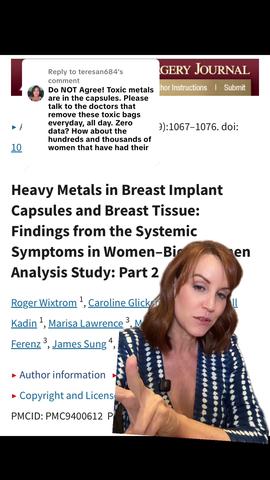
Do "Heavy Metals in Breast Implant Capsules" Cause BII? What the Research Actually Shows
August 20, 2025
Dr. Killeen responds to the common claim that heavy metals build up in breast implant capsules and require complete capsule removal — by walking through the published study showing heavy metal levels are identical in capsules of symptomatic patients, asymptomatic patients, and women who never had implants.

To BII Survivors Defending Aggressive Explant Surgery: An Open Letter
August 15, 2025
Dr. Killeen writes directly to the BII community of women who had aggressive explant surgery and improved — asking them to reconsider defending that approach for future patients. With the research showing simpler explant achieves equivalent symptom relief without the higher costs, complications, or cosmetic deformity.
Do All Explants Need Total Capsule Removal Because of "Toxins"? No — Here's the Evidence
August 14, 2025
Dr. Killeen answers the common question of whether the toxins causing BII stay in the implant capsule and therefore require total capsule removal. The answer: no identified BII toxin, no measurable difference in heavy metals between capsules and unrelated tissue, and no outcome benefit from capsule removal in BII patients.