Why Breast Implants End Up in Different Positions and How to Fix It
Tincture of time is the best medicine. If you wait a year, 18 months, usually things will just even out with time.
Why Implants Don't Always End Up in the Same Position
Anytime you place breast implants, your body walls them off with scar tissue — and that's completely normal. But as your breasts move with gravity, and because muscle strength, handedness, and healing patterns differ side to side, it's decently common for implants to settle unevenly.
Rule Out Capsular Contracture First
The most important first step is having your plastic surgeon diagnose the actual problem. You always want to make sure the issue isn't a capsular contracture — which can happen on one side or both. This matters because the treatment for contracture is completely different from other positioning issues.
Common Causes of Implants Sitting Too High
Incomplete Muscle Release
With submuscular implants, the pectoralis muscle needs to be properly released on both sides. If it wasn't released enough during surgery, the muscle can hold the implant chronically high. Unfortunately, fixing this requires going back in to release the muscle further.
Overly Tight Muscle
Sometimes the muscle is just holding everything up too tightly. How you address this depends on your implant type:
- Textured implants — usually require a surgical fix
- Smooth implants — you have a better chance of getting them to drop naturally
For smooth implants, surgeons may recommend:
- Massage — pushing the implant downward regularly
- Compression bands — worn across the top of the breasts
- Muscle relaxant medications — to calm the muscle and let the implant settle
- Botox injections — partially paralyzes the pectoralis muscle so it stops fighting the implant. Once the implant drops and stretches the lower scar tissue, the Botox wears off and things typically stay in place
Short Nipple-to-Crease Distance
Some patients — particularly those with tuberous breasts — naturally have a short distance from the nipple to the breast crease. In these cases, the implant may look high, but it's actually in the right position. The issue is limited lower pole tissue.
Time is the best treatment here. The longer you have the implant, the more gravity stretches that lower pole tissue, and the more natural things will look.
When Bodies Just Heal Differently
Sometimes there's no clear explanation — one side just heals a little higher than the other. In many of these cases, tincture of time is the best medicine. If you wait 12 to 18 months, things often even out on their own without any intervention.
If they don't, revision surgery involves making cuts in the capsule (capsulotomy) to allow it to expand so the implant can fall further down into the breast.
Asymmetry Is Normal
Every human being is asymmetric. No one's implants are perfectly symmetric — if you know what to look for, you can always find slight differences. Major asymmetry after implant surgery is uncommon, but minor asymmetry is very common.
The Bottom Line
- Rule out contracture first — it changes everything
- Muscle tightness may need surgical release or Botox
- Smooth implants respond better to conservative measures than textured
- Time fixes many positioning issues — wait 12–18 months before revising
- Work with your surgeon to determine if you have a problem that needs fixing or one that just needs patience
Your Journey to Renewed Confidence

Transform Your Life
Every person deserves to feel comfortable and confident in their own body. Our procedures aren't just about physical change. They're about reclaiming your life, your comfort, and your self-assurance.
Dr. Killeen and her team support you every step of the way, from your first consultation through recovery.
Take the first step toward the life you deserve.
Schedule Your ConsultationTransform Your Life
Every person deserves to feel comfortable and confident in their own body. Our procedures aren't just about physical change. They're about reclaiming your life, your comfort, and your self-assurance.
Dr. Killeen and her team support you every step of the way, from your first consultation through recovery.
Take the first step toward the life you deserve.
Schedule Your ConsultationRelated Articles
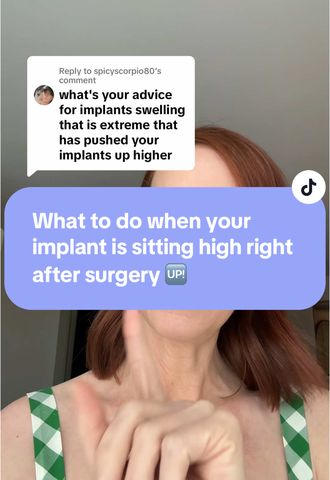
What to Do If Your Breast Implants Are Sitting Too High After Surgery
April 28, 2025
Dr. Killeen explains why breast implants often sit too high in the early weeks after augmentation and what to do. The most common causes are a tight or spasming muscle (under the muscle) or tight tissue that has not stretched yet, both usually fixed by tincture of time and sometimes a strap. She covers why massage probably is not doing much, why it is likely not swelling, and the one red flag — an implant that stays high or keeps rising at four to six weeks, which can signal an early capsular contracture.

How Breast Asymmetry Is Corrected, and What to Tell Your Surgeon
September 17, 2026
There is no single fix for breast asymmetry, because asymmetry is not one thing: nipple position, areola size, crease height, volume, footprint, projection, and chest wall tilt are all different problems with different solutions. Dr. Killeen explains why what bothers you may differ from what your surgeon sees, when fat grafting works well, why position-dependent asymmetry cannot be operated for, and how to name what is actually bothering you before your consultation.
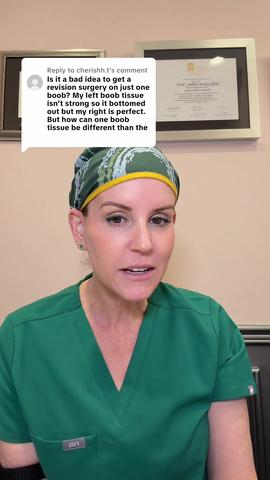
Breast Revision: Should You Fix Just One Side or Both?
October 2, 2025
Dr. Killeen breaks down the real trade-offs of operating on just the problematic breast versus both during a revision, including aging symmetry, surgical control, cost, and complication risk.