Dr. Killeen's Ear Piercing Tour: Current Setup and Favorite Pieces
I'm a mixed metals girl — white and rose gold — and I change my pieces every six months to two years because I get really bored. Ivy at Oak and Poppy is so, so good at figuring out the flow of your ear curation.
Dr. Killeen's Ear Piercing Tour
I haven't done a piercing tour in a few years, and since I've changed out all my pieces, it felt like a good time to share my current ear setup. I'm a mixed metals girl — white and rose gold together — and I love mixing designers between the two ears.
Here's what's in my ears right now.
Left Ear
- Helix — A cute little tree branch by Maria Tash
- Daith — Also a Maria Tash piece
- Two lobe piercings — Both by BVLA (one is a Mini Candy; I can't quite remember the name of the other)
- First lobe piercing — I change this one out all the time depending on my mood
Right Ear
- Rook — A little rose gold diamond hoop by Maria Tash
- Conch — A matching tree branch by Maria Tash, but a bigger version than the one in my left helix
- Two lobe piercings — Both BVLA: little disc-style pieces with a tiny diamond between them (one rose gold, one white gold)
- Another lobe — I think it's the Mini Gaia by BVLA, in rose gold
I absolutely love all of them, and the mixed metals theme is what ties the whole curation together.
Why I Change Them Every 6 Months to 2 Years
I get bored. That's it — that's the reason. Rotating pieces keeps my ear feeling fresh, and I like being able to play with different looks as my style evolves. The current setup will probably stay for another six months to a year before I start itching to change it again.
One thing I'll be honest about: I'm not good at changing my own cartilage piercings out. I always go in and have them swapped by a pro — it's so much easier and more comfortable.
Who Does My Piercings
Almost all of my piercings were done by Sean at Oak and Poppy, and he's incredible.
The person who styles me there — meaning helps figure out the overall flow and curation of my ear — is Ivy Jimenez. I adore her. She's extraordinarily good at:
- Looking at your ear shape and existing pieces
- Figuring out where the next piercing should go
- Choosing pieces that feel cohesive rather than random
- Walking you through healing
Ivy recently pierced my daughter, and she picked the cutest little pieces for her — a tiny moon and a tiny lightning bolt. I'll share a picture of her ear later this week because it's adorable.
If you're intimidated by a multi-piercing look and want someone to help you build it thoughtfully, I can't recommend Oak and Poppy — and Ivy in particular — highly enough.
Maria Tash Is Also Wonderful
Maria Tash also does piercings, and while I haven't had an initial piercing done there, they've changed pieces out for me and have been lovely. Sebastian is the last one who swapped mine there — also excellent. But for curation and healing support, Ivy's my girl.
The Bottom Line
Current setup: a mix of Maria Tash and BVLA across both ears, mixed metals in white and rose gold, pierced by Sean at Oak and Poppy and curated by Ivy Jimenez. I'll change them all out again in six months to a year — but for now, I love every single one of them.
Your Journey to Renewed Confidence
Transform Your Life
Every person deserves to feel comfortable and confident in their own body. Our procedures aren't just about physical change. They're about reclaiming your life, your comfort, and your self-assurance.
Dr. Killeen and her team support you every step of the way, from your first consultation through recovery.
Take the first step toward the life you deserve.
Schedule Your ConsultationTransform Your Life
Every person deserves to feel comfortable and confident in their own body. Our procedures aren't just about physical change. They're about reclaiming your life, your comfort, and your self-assurance.
Dr. Killeen and her team support you every step of the way, from your first consultation through recovery.
Take the first step toward the life you deserve.
Schedule Your ConsultationRelated Articles

In-Office Revisions After a Breast Reduction: Dog Ears and Nipple Inversion
June 9, 2026
Dr. Killeen explains the two most common revisions after a breast reduction — dog ears and nipple inversion — including why they happen, why they often resolve on their own, the in-office options (Kybella, excision, nipple piercing, surgical correction), and the important breastfeeding consideration before correcting inversion.

What's That Coming Out of My Incision? Stitch, Gauze, or Mesh
September 11, 2026
Patients keep posting videos of things found at their incision, convinced a piece of an instrument or dressing is coming out of them. Dr. Killeen walks through how to identify what you are actually looking at: dissolving stitch goo, a leftover black or blue non-dissolvable thread, gauze or clothing fiber stuck in dressing adhesive, or a woven piece of dissolvable mesh or a hemostatic agent like Surgicel. None of it means something went wrong.
Breast Surgery Scaffolds, Ranked: My Favorites, My Least Favorites, and Why
July 13, 2026
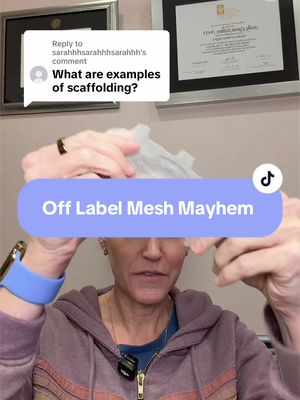
Dr. Killeen gives a candid, product-by-product guide to the scaffolds used in breast surgery — acellular dermal matrix (AlloDerm, FlexHD, Cortiva), the pig version Strattice she dislikes, the off-market disaster SERI Scaffold, and the dissolvable meshes GalaFLEX (her favorite, for its anti-inflammatory and anti-microbial peptides that reduce seromas and help with contracture), TIGR Matrix (close second), plus DuraSorb and OviTex, which she likes least. She also explains how she decides whether to use one at all. Note: all are off-label in the breast.