What Is Recovery Like Moving Implants From Under to Over the Muscle?
Recovery from this procedure is actually a little easier than a primary augmentation under the muscle.
Under the Muscle vs Over the Muscle
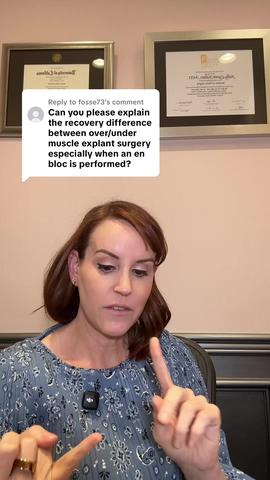
If you currently have breast implants placed under the muscle and you're considering moving them over the muscle, you might be wondering — what's recovery actually like?
Easier Than You Might Expect
For most patients, I find that recovery from this procedure is actually a little easier than a primary augmentation under the muscle. When we repair the muscle back to the chest wall, that does add a bit more tenderness to the post-op recovery period. But I use long-acting numbing agents in the operating room, and the medications we use with ERAS protocols typically leave patients pretty comfortable.
Timeline
The average patient after having a muscle repair and implant plane change follows this general timeline:
- Back to work: within one week
- Back to driving: within one week
- Off pain medicines: five to seven days
- Light activity: after four weeks
- Full exercise (heavy lifting, running, push-ups): one to two months
It's very rare for this patient population to actually use any of their opioid medicines. They have a prescription and they never use them.
Why Four Weeks Before Exercise?
After a muscle repair, we want to give the pectoralis major muscle enough time to heal and scar down to the chest wall where we've sutured it. So you do need to behave yourself for about four weeks when it comes to exercise. But I typically release patients to do anything they want at one month, and by two months people are usually back to everything — even heavy lifting and push-ups.
What Is ERAS?
ERAS stands for Enhanced Recovery After Surgery. We've studied these protocols for quite some time in medicine across a variety of different surgeries. Our goal as surgeons is to make your recovery as easy as possible, and all of these advances have done exactly that.
In summary, switching implants from under the muscle to over the muscle with a muscle repair is a bit easier recovery than a primary breast augmentation. But for both surgeries, recovery is pretty manageable for the average patient — especially with modern ERAS protocols.
Your Journey to Renewed Confidence

Transform Your Life
Every person deserves to feel comfortable and confident in their own body. Our procedures aren't just about physical change. They're about reclaiming your life, your comfort, and your self-assurance.
Dr. Killeen and her team support you every step of the way, from your first consultation through recovery.
Take the first step toward the life you deserve.
Schedule Your ConsultationTransform Your Life
Every person deserves to feel comfortable and confident in their own body. Our procedures aren't just about physical change. They're about reclaiming your life, your comfort, and your self-assurance.
Dr. Killeen and her team support you every step of the way, from your first consultation through recovery.
Take the first step toward the life you deserve.
Schedule Your ConsultationRelated Articles
Explant Recovery: Under vs. Over the Muscle, and What Adding a Capsulectomy Actually Costs
August 7, 2025
Dr. Killeen breaks down how explant recovery differs based on whether the implant was under or over the muscle, what adding a capsulectomy does to your complication risk (it goes up, mainly from bleeding), and why en bloc capsulectomy should essentially never be performed outside of documented capsule cancer.

After a Single Mastectomy, Why the Two Sides Settle Differently
September 4, 2026
Yes, you can have surgery on the non-cancerous breast for symmetry, and it is typically covered by insurance as a symmetry procedure. Dr. Killeen explains the options for that side (nothing, a lift, a lift with a small implant, an implant, or a reduction), why the two sides usually do not look even right away (the mastectomy side has already settled while the symmetry side has never been operated on), why coming out larger is safe according to data she and her partner published, what adding fat grafting really costs you in recovery, and why the two breasts will age differently over the years.

Very Little Tissue and Considering a Breast Augmentation: Under or Over the Muscle?
June 15, 2026
Dr. Killeen breaks down the under-vs-over-the-muscle decision for thin breast augmentation patients — the traditional pinch test, why modern cohesive implants and fat grafting have changed the old rules, and the overlooked trade-off: thin patients see the implant more under the muscle, but they also see the muscle move more.