When a Patient Targets Their Physician Online: A Hard Conversation Without an Easy Answer
It's heartbreaking to watch a friend who spent decades training to care for people get decimated online with no recourse — and equally heartbreaking that the person causing the harm is often someone in genuine crisis. There are no real winners in these viral situations.
When a Patient Targets Their Physician Online: A Hard Conversation Without an Easy Answer
A situation is all over my For-You page right now — a woman publicly accusing her psychiatrist of various forms of manipulation and harm. The specifics aren't what this post is about. What I want to talk about is the broader phenomenon that's being illustrated, because it's genuinely upsetting to watch, and it's happening more and more often.
This is about what happens when a patient — especially a patient who may be unwell — uses social media to target the physician caring for them, and what that means for both sides of the situation.
I've Watched This Happen Twice to Friends
I want to start with this because it grounds the conversation in something real.
I have two close colleagues who have experienced versions of what's playing out publicly right now. Not the same situation, not as viral, but the same fundamental pattern:
- A patient becomes fixated on the physician
- The relationship deteriorates
- The patient takes the dispute online
- The physician is harassed, smeared, and accused publicly
- It goes on for years
I cannot fully describe how horrible it is to watch a friend who has spent decades training to care for people get decimated online by someone they were trying to help — with essentially no recourse.
The Structural Problem
Here's what makes this situation uniquely difficult:
1. Physicians Can't Defend Themselves
Even when the accusations are inaccurate, physicians cannot publicly respond with the patient's side of the story. HIPAA exists for important reasons, and a physician sharing information about a patient — even to defend themselves — is a violation. So the doctor sits in silence while the accusations multiply.
This is the heart of the asymmetry: the patient can say anything, the physician can say nothing.
2. Suing Is Hard
Defamation lawsuits exist. In theory, a physician can sue a patient who is publicly defaming them.
In practice:
- Hard to prove
- Expensive
- Time-consuming — often years to resolve
- The information remains online the entire time, often forever
- A successful judgment doesn't erase the damage to reputation
- Suing a patient can itself create reputational damage for the physician
Some physicians have successfully pursued this route. But it is extraordinarily difficult, and very few cases get to a meaningful resolution.
3. Platform Moderation Is Effectively Absent
Social media platforms have almost no infrastructure for situations like this:
- There's no "this person is in an active mental health crisis and is targeting their treatment provider" button
- Reports of harassment frequently get rejected by automated review
- Even when accounts get suspended, new accounts appear
- The information remains searchable, screenshot-able, and replicable
In the absence of meaningful platform moderation, this kind of targeted harassment can persist indefinitely.
Why This Is So Devastating for the Physician
I want to give voice to the physician side, because it's genuinely under-discussed.
Consider what a physician's career path looks like:
- 4 years of college
- 4 years of medical school
- 3 to 7 years of residency
- Often a 1 to 3 year fellowship
- Years of building a practice and a reputation
- A career fundamentally built on the trust of patients and the broader community
And then, in the modern environment, one patient with enough motivation and a working internet connection can:
- Post sustained, public accusations
- Generate viral content that millions of people see
- Permanently embed accusations into the physician's searchable record
- Drive away current and future patients
- Cause real harm to mental health, livelihood, and well-being
For physicians who built their entire identity around helping people, watching that work get public destroyed by someone they tried to care for is uniquely traumatic. The two friends I mentioned earlier have been terrorized for years in lower-grade versions of this exact pattern.
The Empathy I Also Hold
Here's the part that makes this even more complicated for me as a clinician: the person doing the harm is, very often, someone who is genuinely struggling.
The patterns we see in these viral situations frequently include:
- Acute or chronic mental illness
- Fixation that's often a symptom of an underlying disorder
- Patterns of behavior consistent with significant emotional distress
- An obvious need for support and treatment
So while I'm heartbroken for the physicians on the receiving end, I'm also heartbroken for the patient. She is publicly hurting other people — and she is, herself, clearly hurting.
This isn't a villain-and-victim story. It's a situation where:
- The physician is being genuinely harmed with no recourse
- The patient is genuinely suffering, and her behavior is part of that suffering
- The internet is amplifying the worst possible expression of someone in crisis
- Everyone involved is worse off than they were before the content went viral
What I Wish Existed
I want to share something I said in the original video that I think captures the wish: I wish there were a "please delete this person's profile" button that we could collectively push — not to silence anyone, not to take away their voice — but as a pause.
A pause for someone who is in obvious crisis, posting things they may regret, harming someone they were once asking for help from. A pause that gives them a chance to come back to themselves before more damage is done.
The current internet has no such mechanism. It's an environment designed to amplify, not to pause. And the patients who are most likely to use it in these damaging ways are often the patients who would most benefit from someone gently slowing the spiral.
What Can We Actually Do?
I don't have great answers. But a few thoughts:
For Physicians
- Maintain meaningful malpractice insurance that includes some defamation/protection coverage
- Document interactions thoroughly, especially if a patient relationship is deteriorating
- Set clear boundaries early — written, mutually-acknowledged
- Have a plan for what you'll do if you ever become a target (legal counsel, mental health support, peer network)
- Take threats seriously — if a patient is escalating, don't pretend it's normal
- Take care of yourself — being targeted publicly is genuinely traumatic, and treating it as such matters
For Patients
If you find yourself in conflict with your physician, please consider:
- Speak directly first — most disputes resolve when there's a real conversation
- Use formal complaint channels — state medical boards, hospital complaint systems, malpractice routes — that allow your story to be heard without permanent public defamation
- Talk to a therapist about strong feelings toward a treatment provider — this is genuinely common and worth working through with another professional, not publicly
- Remember that viral attention is not justice. It feels like power. It rarely heals anything.
For the Rest of Us Watching
When these situations go viral, the audience plays a role too. A few things worth holding:
- Be careful about amplifying one-sided accusations against any professional, including physicians
- Recognize the asymmetry — the physician likely can't legally respond
- Don't assume the loudest version of the story is the most accurate
- Have compassion for both parties when it's clear someone is in crisis
The Bottom Line
The phenomenon of unwell patients targeting their physicians publicly is happening more, not less. The structural problems — HIPAA preventing rebuttal, defamation law being slow, platforms refusing to moderate — make it devastating for the physicians on the receiving end, often for years.
It's also a sign that the patient is genuinely struggling and needs help they're currently not getting.
I don't have a clean answer. I just want to name what I'm watching, defend my colleagues who are being decimated with no recourse, and hold space for the fact that the person doing the damage often also needs care.
And to my friends who have lived through this in smaller, quieter ways — I see you. I'm sorry. You didn't deserve any of it.
Your Journey to Renewed Confidence

Transform Your Life
Every person deserves to feel comfortable and confident in their own body. Our procedures aren't just about physical change. They're about reclaiming your life, your comfort, and your self-assurance.
Dr. Killeen and her team support you every step of the way, from your first consultation through recovery.
Take the first step toward the life you deserve.
Schedule Your ConsultationTransform Your Life
Every person deserves to feel comfortable and confident in their own body. Our procedures aren't just about physical change. They're about reclaiming your life, your comfort, and your self-assurance.
Dr. Killeen and her team support you every step of the way, from your first consultation through recovery.
Take the first step toward the life you deserve.
Schedule Your ConsultationRelated Articles
Why Doctors Don't Give Free Medical Advice on Social Media
October 20, 2025
Dr. Killeen responds to a common comment — "it's ironic that doctors argue on TikTok but won't give you free medical advice" — and explains why no responsible physician can safely give individualized medical advice through DMs, why it's a real legal liability, and what helpful use of medical content actually looks like.
What Happens When a Doctor Realizes They Don't Love Their Specialty?
March 19, 2025
Dr. Killeen responds to Dr. Frances Mei on something medicine rarely discusses: what happens when you are years into a specialty and realize it is not for you. She explains why residency structurally locks physicians in, why it is so hard to tell early misery from genuine mismatch, and shares the story of a surgical critical care fellow who told her mentors every year for five years that surgery was not for her and was told each time that it gets better. She also pushes back on the idea that physicians should tolerate any treatment out of gratitude for getting in.
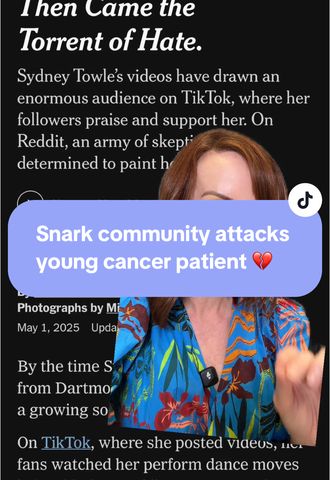
Syd Towle, Cholangiocarcinoma, and the Cruelty of Online "Snark"
May 1, 2025
A New York Times article documented how an organized online "snark" community harassed Syd Towle, a young woman with stage four cholangiocarcinoma, accusing her of faking her cancer and even calling her cancer centers. Dr. Killeen, who has cared for cancer patients her whole career, reflects on why there is no "right" way to behave facing a life-threatening diagnosis, how the Times verified the diagnosis, and how social media groups pull ordinary people into extraordinary cruelty.