Why Do Breast Implants Flip? AP Malposition Explained
In a perfect world, you have a Goldilocks capsule — just big enough to hold the implant, not too tight, but just right.
Why Do Breast Implants Flip? Understanding AP Malposition
If your breast suddenly changes shape, you might think your implant has ruptured — but it may have actually flipped. We call this AP malposition (anterior-posterior malposition), where the round front side of the implant rotates to the back, and the flat backside ends up in front.
Why Does This Happen?
This happens when the capsule — the scar tissue sac your body forms around the implant — becomes too large and allows the implant to spin too easily.
In a perfect world, you have a Goldilocks capsule: just big enough to hold the implant, not so tight that it causes a weird shape, but snug enough to keep the implant in place. If the capsule stretches over time and becomes weak, it gets bigger — and the implant is more likely to flip.
When Do We See This Most?
High or Extra-High Profile Implants
These implants are more ball-like. They're not as flat, so they spin more easily inside an enlarged capsule.
Under-the-Muscle Augmentations
The repeated pressure of the pectoralis muscle on the implant stretches the lower capsule and enlarges it over time. I see flipped implants more often in my submuscular patients.
Very Large Implants
Big, heavy implants stretch the capsule more, making it too large relative to the implant — which allows it to flip.
Can It Be Fixed Without Surgery?
If your implant has flipped and it's the first time, we can often flip it back manually — and it will usually stay in place.
But if you've developed a capsule that's much larger than the implant, especially with high-profile implants, it might start repeatedly flipping. Some patients even experience pain when the implant is upside down.
If that's the situation, unfortunately the only fix is revision surgery to address the capsule and stabilize the implant.
The Bottom Line
A flipped implant isn't a rupture — it's a capsule problem. It's more common with high-profile implants, submuscular placement, and larger implants. If it keeps happening, surgery is the only reliable solution.
Your Journey to Renewed Confidence

Transform Your Life
Every person deserves to feel comfortable and confident in their own body. Our procedures aren't just about physical change. They're about reclaiming your life, your comfort, and your self-assurance.
Dr. Killeen and her team support you every step of the way, from your first consultation through recovery.
Take the first step toward the life you deserve.
Schedule Your ConsultationTransform Your Life
Every person deserves to feel comfortable and confident in their own body. Our procedures aren't just about physical change. They're about reclaiming your life, your comfort, and your self-assurance.
Dr. Killeen and her team support you every step of the way, from your first consultation through recovery.
Take the first step toward the life you deserve.
Schedule Your ConsultationRelated Articles

The Lift Chooses the Patient: Lollipop Lifts and Reusing Implants
August 28, 2026
Dr. Killeen answers two questions at once: yes, she does lollipop lifts all the time, and the lift pattern should be chosen by your anatomy rather than your scar preference. She also lays out exactly when reusing a breast implant is reasonable, when it never is, and why she does not believe a "mild" capsular contracture exists.

"My Compression Garment Was Sitting Too High and Pushed My Breasts Up — Did I Ruin My Result?"
June 2, 2026
Dr. Killeen reassures post-op patients who accidentally wore their compression garment too high and pushed their breasts up out of position. Including a real-world example of a patient whose implants were sitting at her collarbones from a too-small bra — and how everything settled back without surgery.
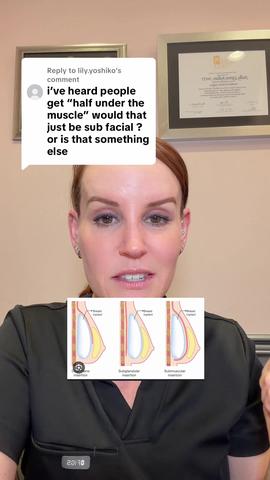
Subglandular, Submuscular, Dual Plane, Subfascial — Implant Placements Explained
October 21, 2025
Dr. Killeen breaks down the four most common breast implant placements — subglandular, submuscular, dual plane, and subfascial — what each one means anatomically, what the trade-offs are with animation deformity and biofilm, and how to think about which is right for you.