Why Didn't the OR Team Stop Surgeon Thomas Shaknovsky?
The staff often can't see what I'm doing as a surgeon. Depending on what you're doing and where the anatomy is, the rest of your team often can't see what's going on.
Why Didn't Anyone in the OR Stop Him?
After my last post about surgeon Thomas Shaknovsky, the most common question in the comments was: "There are other people in the operating room — why did none of them stop the surgeon who accidentally removed the liver?"
It's a fair question, and the answer requires understanding who is actually in the OR, what they're doing, and what they can realistically see. The short version is: the staff is not at fault here. Here's why.
Who Is Actually in the Operating Room?
A bare-bones operative team for most surgeries is four people:
- The surgeon — performing the operation.
- The scrub tech or scrub nurse — in charge of sterility, keeping instruments and supplies organized, and assisting the surgeon.
- The anesthesiologist — keeping the patient comfortable, safe, and stable throughout the case.
- The circulating nurse — the non-sterile support system who handles documentation, opens supplies, and makes sure we have everything we need on the sterile field.
There may be an additional person if the surgeon has an assist — a PA, another surgeon, or a medical student. But four is the standard minimum.
Misconception #1: "The Staff Was Just Watching"
The first thing to understand is that the staff in the room is not sitting around observing the surgeon. Every single person is actively working.
When a case is going smoothly, that's true. When a case is going sideways, it's even more true:
- The circulating nurse may be opening multiple instruments and supplies the team suddenly needs.
- The anesthesiologist is working hard to keep blood pressure adequate, transfusing blood products, and pushing medicines.
- The scrub tech is working overtime, handing the surgeon instruments as quickly as possible to manage an unexpected problem.
Everyone is already overloaded.
Misconception #2: "They Could Have Stopped Him"
Even if another team member recognized something was seriously wrong, what exactly do you expect them to do?
- The anesthesiologist can't suddenly throw on sterile gloves and take over control of catastrophic bleeding.
- The scrub tech can't step into the surgeon's role.
- The circulating nurse isn't trained to scrub in and operate.
They don't have the skill set to solve a catastrophic surgical problem mid-case. The best they could do is run out of the room, call another surgeon, try to find help — and all of that takes time.
Catastrophic intra-abdominal bleeding moves fast. I don't have direct experience with this specific scenario, but I've seen my share of trauma cases with catastrophic bleeding, and the reality is that it's frightening and everything is moving quickly.
Misconception #3: "They Saw Him Take Out the Liver"
This is the biggest misunderstanding. The staff often cannot see what the surgeon is doing.
Depending on the procedure and the anatomy being worked on, the surgeon's view is frequently obstructed to everyone else in the room. Some specific factors for this case:
The Patient's Body Size
Mr. Bryan was a larger gentleman. When a larger patient is on the table — even with the operating room table lowered as much as possible — the abdomen still sits quite high. Seeing down and into the abdomen is not easy for anyone who isn't the surgeon. I often stand on a step stool just to get a high enough angle to see what I'm looking at.
The Surgeon Was Working Underneath
The surgeon wasn't pulling the liver up out of the abdomen. He was working underneath the tissue, trying to get control of bleeding. From the team's vantage point, they weren't watching him remove an organ — they were watching him deal with massive bleeding.
Distended Bowel
It was also reported that the patient had a severely distended bowel — one of the reasons the procedure was converted from laparoscopic to open. Distended bowel is bulky, it's everywhere, it's in the way, and it actively blocks visualization for everyone in the room.
When Could the Staff Be at Fault?
There is one scenario where I'd say the staff could bear some responsibility, and it's not the one people assume.
If team members already knew this surgeon was dangerous and hadn't spoken up before.
Outside the OR, in any work environment: if you see something, you should say something. If there were prior cases, prior near-misses, prior concerns — those should have been reported up the chain long before another patient was on the table. That kind of institutional silence is a real problem.
But in the moment, during the actual case? You cannot fairly blame the scrub tech, the anesthesiologist, or the circulating nurse for not physically preventing a disaster they couldn't see and couldn't solve on their own.
The Bottom Line
The staff in Mr. Bryan's operating room was not at fault. They were working as hard as they could in the middle of a catastrophe, with limited visibility and no ability to step into the surgeon's role. The responsibility for what happened in that operation belongs with the person performing it.
If you haven't yet, read the original post on the Shaknovsky manslaughter charges for the full context of the case.
Your Journey to Renewed Confidence

Transform Your Life
Every person deserves to feel comfortable and confident in their own body. Our procedures aren't just about physical change. They're about reclaiming your life, your comfort, and your self-assurance.
Dr. Killeen and her team support you every step of the way, from your first consultation through recovery.
Take the first step toward the life you deserve.
Schedule Your ConsultationTransform Your Life
Every person deserves to feel comfortable and confident in their own body. Our procedures aren't just about physical change. They're about reclaiming your life, your comfort, and your self-assurance.
Dr. Killeen and her team support you every step of the way, from your first consultation through recovery.
Take the first step toward the life you deserve.
Schedule Your ConsultationRelated Articles
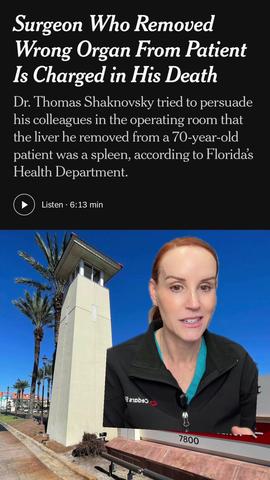
Surgeon Thomas Shaknovsky Charged With Manslaughter: What Actually Happened
April 15, 2026
Dr. Killeen reacts to the news that surgeon Thomas Shaknovsky has been charged with manslaughter after removing a patient's liver instead of his spleen — and explains why this case is beyond a normal surgical complication.
Who Should Actually Call You With a Biopsy Result?
November 12, 2025
Dr. Killeen explains why biopsy results with a diagnosis, treatment plan, or life-changing news should come from a physician, NP, or PA — not left on voicemail — and what every good diagnosis call should include.
Who Is Actually Giving Your Anesthesia?
January 28, 2025
Patients vet the surgeon and sometimes the facility, then hand themselves to a third professional they never researched. Dr. Killeen explains that she works only with physician anesthesiologists, why she prefers the care team model or a physician alone, and the one question to ask if a CRNA is doing your anesthesia: who is your backup, because it should not be the surgeon. Plus why liposuction volume is a safety question and the rest of her pre-surgery checklist.