Why Is the Operating Room Warm During Liposuction?
Cold patients don't clot well, don't process medications normally, and get more infections. With large-volume lipo, so much of the body is exposed that we sometimes have to warm the entire room. Pediatric and burn surgery rooms are kept even hotter — and the surgeons sweat through it.
Why Do We Keep the Operating Room Warm During Liposuction?
A great question came in: "Why do you keep the operating room warm when someone's having lipo?"
Short answer: it's not actually unique to lipo — we always care about keeping patients at normal body temperature during surgery. But large-volume liposuction is a setup where it's harder to keep the patient warm, so we sometimes have to actively heat the room as one of several strategies.
Let me walk through why temperature matters so much in surgery, and why liposuction patients are at higher risk of getting cold.
Why Body Temperature Matters in Surgery
When a patient's body temperature drops too low during surgery, several genuinely bad things start happening:
1. Coagulopathy — Increased Bleeding
Cold patients don't clot well. Specifically:
- Clotting factor activity decreases at lower temperatures
- Platelet function is impaired
- Bleeding becomes harder to control intraoperatively
- More blood loss across the case
This is one of the major mechanisms by which hypothermic patients have worse outcomes. We saw this play out tragically in the recent Joy Barbera case, where the patient's recorded intraoperative body temperature was reportedly around 90°F — and hemorrhagic shock was reported on autopsy.
2. Impaired Medication Metabolism
Drugs given during surgery — anesthetics, antibiotics, blood pressure medications — get metabolized differently when the patient is cold. Doses can:
- Last longer than expected
- Build up unpredictably
- Create unexpected reactions when other medications are given
This makes anesthesia management harder and increases risk.
3. Increased Surgical Site Infections
Hypothermia during surgery has been associated with higher rates of surgical site infection afterward. The reasons are complex (vasoconstriction reducing immune cell delivery to the wound, impaired neutrophil function, etc.) — but the data is clear: keeping patients warm helps prevent post-op infections.
4. Slower Wake-Up and Recovery
Cold patients take longer to wake up from anesthesia, longer to recover in PACU, and have higher rates of post-anesthesia discomfort.
So across the board, normothermia (normal body temperature) is critical in any surgery — not just liposuction.
Why Liposuction Is Specifically Tricky
Liposuction isn't inherently warmer or cooler than other surgeries. The issue is that for large-volume liposuction or 360-degree liposuction, the patient's body is exposed over a large surface area during the entire procedure.
What Happens During a Big Lipo Case
- Much of the abdomen, back, flanks, and thighs may be exposed simultaneously
- The patient is being rotated during the procedure (supine to prone, side to side)
- Tumescent fluid (room-temperature or slightly warmed saline with local anesthetic) is being infused into the tissue
- The patient cools down much faster than in a typical procedure
In a typical single-area surgery (say, a breast augmentation), we have:
- Drapes covering most of the body
- A warming blanket (like a Bair Hugger) covering exposed areas
- A focused, controlled exposure of just the surgical field
- Generally good temperature control
In a large lipo case, we lose a lot of these advantages because so much of the patient's body is uncovered.
What We Do to Compensate
When standard warming techniques aren't enough, we add other layers:
- Warming the room itself to a higher temperature
- Warmed tumescent fluid infused into the tissue
- Strategic drape and blanket placement between positions
- Closer-than-usual temperature monitoring throughout the case
So when patients ask "why is the OR so warm during lipo?" — it's because we're working harder than usual to keep them at a normal body temperature.
Other Surgeries Where the Room Is Genuinely Hot
For context, there are two specific situations where the OR is kept much warmer than even a lipo case:
Pediatric Surgery (Especially Neonates)
- Babies, especially newborns, lose body heat extraordinarily quickly
- Their body surface area is large relative to body mass
- They don't shiver effectively to generate heat
- Operating rooms for neonates are kept very warm — sometimes uncomfortably so for the surgical team
Burn Surgery
- Patients with large body-surface-area burns have lost their skin barrier
- Without intact skin, they lose enormous amounts of heat very quickly
- Hypothermia is a major risk in these patients
- Burn ORs are kept very hot
What This Looks Like for the Surgical Team
In rooms kept this warm, the experience for the surgeons is genuinely uncomfortable:
- We're wearing insulated surgical gowns
- The bright surgical lights add heat
- Long cases in these rooms can become miserable for the team
But the patient's temperature comes first. We sweat through it.
The Practical Patient Takeaway
A few things worth knowing if you're scheduled for a procedure — particularly one with significant body exposure:
Ask About Temperature Management
For larger procedures, it's reasonable to ask your surgeon:
- "How do you keep me warm during the procedure?"
- "Do you monitor my temperature continuously?"
- "At what point would you stop or adjust the procedure if I were getting cold?"
Good surgeons and anesthesiologists are taking this seriously. Hearing it confirmed should be reassuring.
Be Wary of Massive Combined Cases
This connects back to the Joy Barbera case: the longer and more extensive the operation, the more physiologically stressful it is, and one of the failure modes is getting too cold.
The published 7 liters of liposuction + multiple major procedures + 90°F body temperature combination in that case is a textbook setup for the hemorrhagic shock that was reported. Surgery teams that combine many large procedures into a single 10-hour operation are accepting these compounding risks — and patients deserve to know what those risks are.
This is one of many reasons I personally cap my outpatient liposuction at 5 liters even when state law allows more, and why I think aggressively combined procedures should give patients pause.
Your Body Will Try to Tell Us
Modern OR monitoring catches hypothermia in real time:
- Continuous core temperature monitoring is standard
- We respond to temperature drops as they happen
- We don't simply push through if a patient is getting dangerously cold
In a well-run OR, your temperature is being watched as carefully as your heart rate and blood pressure.
The Bottom Line
The OR is kept warmer during liposuction because large-volume lipo exposes more of the patient's body, making it harder to maintain normal temperature. Hypothermia in surgery causes:
- More bleeding (coagulopathy)
- Unpredictable medication effects
- Higher infection rates
- Slower recovery
For most surgeries, drapes, warming blankets, and warmed fluids are enough. For big lipo cases — and especially for pediatric and burn surgery — we add room-temperature heating on top of all of that. The surgeons get hot. The patients stay safe. That trade-off is worth it.
If you're planning a procedure with significant body exposure, ask your surgeon about temperature management. A team that takes it seriously is one of many indicators of a well-run operation.
Your Journey to Renewed Confidence
Transform Your Life
Every person deserves to feel comfortable and confident in their own body. Our procedures aren't just about physical change. They're about reclaiming your life, your comfort, and your self-assurance.
Dr. Killeen and her team support you every step of the way, from your first consultation through recovery.
Take the first step toward the life you deserve.
Schedule Your ConsultationTransform Your Life
Every person deserves to feel comfortable and confident in their own body. Our procedures aren't just about physical change. They're about reclaiming your life, your comfort, and your self-assurance.
Dr. Killeen and her team support you every step of the way, from your first consultation through recovery.
Take the first step toward the life you deserve.
Schedule Your ConsultationRelated Articles
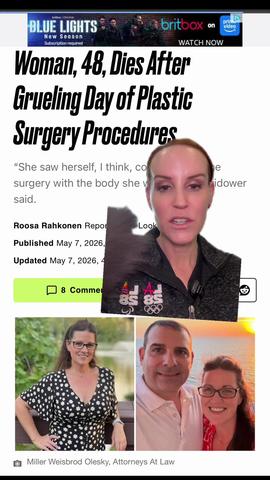
A Tragedy in the News: Joy Barbera and the Risks of Stacking Cosmetic Procedures
May 8, 2026
Dr. Killeen analyzes the publicly reported facts of the Joy Barbera case — a 48-year-old woman who passed away after a 10-hour operation combining an arm lift, breast augmentation, 360 liposuction, BBL, and lower body lift — and the broader lesson for patients about why staging matters when multiple surgeons recommend it.
Can You Injure Abdominal Organs During Liposuction? Yes — Here's What Surgeons Do to Prevent It.
July 3, 2025
Dr. Killeen explains how abdominal organ injury (including bowel injury) can happen during liposuction of the abdomen — and why the highest-risk moment is actually during the numbing infiltration, not the fat removal. Plus what surgeons and patients can do to lower the risk.
Why Didn't the OR Team Stop Surgeon Thomas Shaknovsky?
April 16, 2026
Dr. Killeen answers the most common follow-up question about the Shaknovsky case: why didn't the other staff in the operating room stop him? She breaks down who's in the OR, what they do, and why they often can't see what the surgeon is doing.