Will Insurance Cover Your Breast Reduction?
How you do one thing is how you do all. You don't want a surgeon that lies.
Will Insurance Cover Your Breast Reduction and Lift?
The short answer: if you meet your insurance company's criteria, yes — breast reduction is often a covered procedure. But there are several important things to understand before assuming your surgery will be paid for.
Every Breast Reduction Includes a Lift
First, a clarification: all breast reductions come with a lift. You don't have to pay extra or do anything extra — the lift is part of the reduction procedure.
Two Types of Breast Reduction
1. Oncoplastic Reduction (Cancer Patients)
If you're a cancer patient having treatment and getting a reduction at the same time, this is called an oncoplastic reduction. This type is essentially always covered — even if the reduction is small.
2. Standard Breast Reduction
A standard breast reduction to make the breasts smaller is more complicated from a coverage standpoint. Here's how to navigate it:
Step 1: Check If Your Plan Covers It
Unfortunately, some insurance plans list breast reduction as an exclusion, meaning it will never be covered regardless of medical need. Start by confirming your plan isn't one of them.
Step 2: Meet the Criteria (the Schnur Scale)
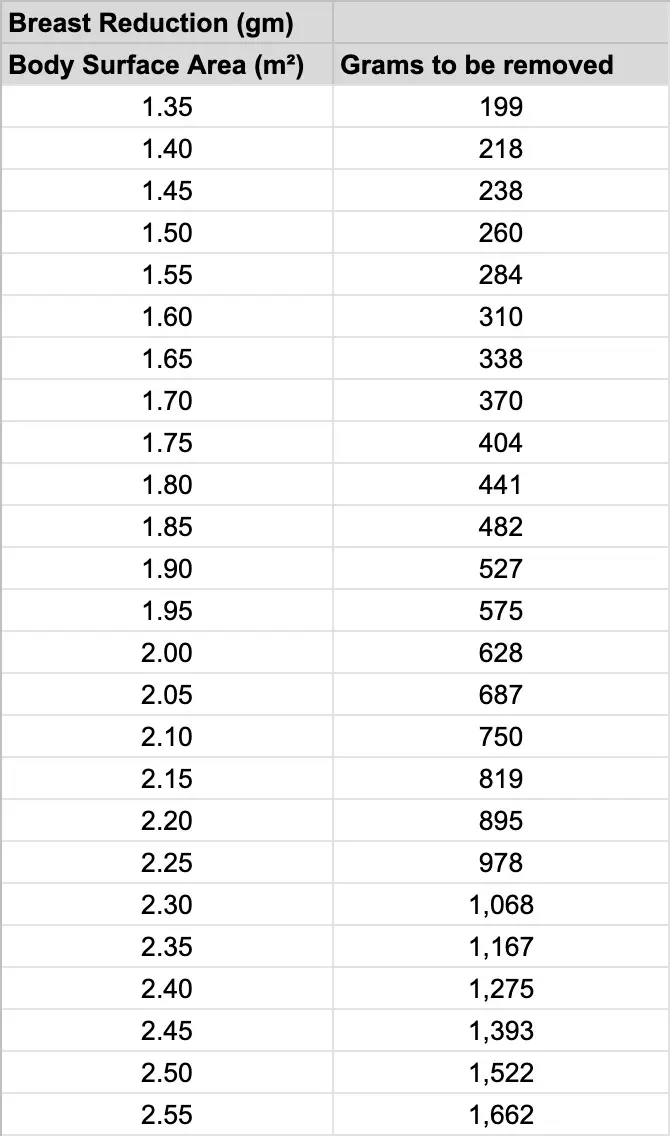
Want your number right now? I built a free Schnur scale calculator that estimates the minimum grams per breast your plan is likely to require, based on your height and weight, and shows the full published chart.
Most insurance companies use the Schnur scale to determine coverage. They take your height and weight, calculate your body surface area, and match it to a minimum weight of tissue that must be removed from each breast.
Every insurer has its own little chart, and they're always a little bit different. But the structure is the same: one column is your body surface area, and next to it is an amount in grams that has to come off each side.
One clarification worth making, because these two numbers get confused constantly: body surface area is not BMI. We calculate body surface area from your height and your weight as its own measurement. Some plans separately impose a BMI cutoff (more on that below), but that's a different number doing a different job.
- Smaller body surface area = smaller requirement
- Larger body surface area = larger requirement
For reference, a soda can weighs about 355 grams — so if your plan requires 500 grams from each side, that's more than a soda can per breast.
Why You Can't Judge This From a Photo Online
This is worth keeping in mind when you're scrolling before-and-afters and thinking that surgeon barely took anything off, how was that covered?
When you look at a photo, you don't know the size of that patient. You don't know their height and weight, so you don't know their body surface area. What doesn't look like a lot of tissue to you may, once you take the whole picture into account, be more than enough to meet their Schnur number.
The number is relative to the person. You can't eyeball it from an image.
Important note: Dr. Schnur himself does not want his research used this way, and the American Society of Plastic Surgeons has a statement against this method. But unfortunately, this is what insurers use.
Step 3: Additional Documentation (Sometimes)
Some insurance companies also want:
- A letter from another doctor supporting the need for surgery
- Documentation of physical therapy
- Evidence of complications from large breasts (rashes, infections)
Dr. Killeen has found that many insurance companies don't require these extras anymore — it's become more of a pure numbers game. But if you've been to physical therapy or a chiropractor, bring those notes to your consultation to include with the pre-authorization.
Two Situations Where Schnur Doesn't Apply
Most patients do have to meet the Schnur number. But there are two situations where you may not have to meet Schnur and can still get your reduction covered.
1. Breast Cancer
One of the ways we treat breast cancer is with a lumpectomy, removing a piece of tissue with the cancer in the middle of it. If that lumpectomy is going to be relatively large, it can distort the breast.
In that case, a plastic surgeon can perform a reduction on both sides to restore symmetry and correct any contour deformity the lumpectomy creates. This is an oncoplastic reduction, and here the number of grams removed doesn't matter.
2. Congenital Breast Deformities
This one is rarer and far less well known: patients with congenital deformities of the breast, such as tuberous breast deformity.
I've had patients whose breast reduction was covered as treatment for their tuberous breast deformity, to improve symmetry and shape, and they were not required to hit a specific gram threshold.
If you have a congenital breast deformity, it is genuinely worth having your surgeon explore this route rather than assuming Schnur is the only door.
And One Rarer Scenario Beyond Those Two
I said two, and those are the two that actually come up with any regularity. There's a third that's rare enough I hesitate to list it beside them, but it's worth knowing exists.
Rarely, even when we're removing a non-cancerous lesion, we can get a reduction, or even a lift, covered as part of restoring the breast afterward.
I want to be honest about the odds: this is a lot harder than the cancer route, and it isn't something to count on. But if you're already scheduled to have a benign mass removed and you've been told a reduction is out of reach, it's a question worth asking rather than assuming the answer.
A Frustrating Note About the Evidence
It's worth saying plainly: multiple studies have now shown that breast reduction delivers significant benefit even for patients who don't meet the Schnur number. The relief from neck, back, and shoulder symptoms doesn't politely wait for a body-surface-area calculation.
Unfortunately, the gram threshold remains the insurance industry standard, and it's what insurers require regardless of what the research says.
Just Because You Can Doesn't Mean You Should
Here's a part of this conversation that gets skipped, and it matters as much as the coverage question.
It isn't really about the size you're starting at, it's about how many grams we can remove. So once you know your number, there's a second question to ask:
Will removing that much tissue actually leave you at a size and proportion that makes you happy?
Sometimes the amount an insurance company requires is more than a patient actually wants removed. Hitting the number gets your surgery covered, but it may leave you smaller than you envisioned. That's a real trade-off, and it deserves an honest conversation with your surgeon before you commit, not a discovery you make afterward.
So yes, talk about whether you can get covered. But also talk about whether the covered version is the result you actually want.
The BMI Cutoff Problem
Some insurers have a BMI cutoff, meaning patients above a certain BMI aren't eligible for coverage. Dr. Killeen disagrees with this practice — research shows breast reductions can be performed safely with great benefit even in patients with higher BMIs — but insurance companies often don't align with the research.
"Covered" Doesn't Mean "Free"
Even when your procedure is approved, you'll still likely be responsible for:
- Your deductible — if it's $5,000, you pay at least that
- Coinsurance — depending on your plan
- In-network vs. out-of-network differences — in-network providers are usually cheapest, out-of-network providers cost more
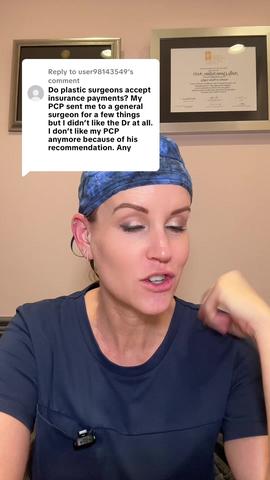
Seeing a Surgeon Who Doesn't Work With Insurance
Some surgeons don't participate with insurance at all. If you find a surgeon you love who doesn't work with insurance, you can:
- Have the surgery with them
- Get your op note and procedure codes
- Submit the documentation to your insurance company for possible reimbursement
This can be difficult to navigate, even with help — but it's an option if you've found the right surgeon.
Don't Ask Your Surgeon to Lie
Dr. Killeen regularly sees comments suggesting surgeons should "just lie" to get insurance approval. Don't do this, and don't look for a surgeon who will.
How you do one thing is how you do all. A surgeon willing to commit insurance fraud is probably cutting corners elsewhere. It can also affect:
- Their board certifications
- Their ability to work with insurance companies
- Their license to practice
You want a surgeon with integrity — both in the office and the operating room.
The Bottom Line
Breast reduction is one of the most life-changing procedures in plastic surgery, and Dr. Killeen wishes every patient who wanted one could have it. If you're considering a breast reduction, schedule a consultation to find out if you meet your insurance criteria and to learn more about what the procedure involves.
Your Journey to Renewed Confidence

Transform Your Life
Every person deserves to feel comfortable and confident in their own body. Our procedures aren't just about physical change. They're about reclaiming your life, your comfort, and your self-assurance.
Dr. Killeen and her team support you every step of the way, from your first consultation through recovery.
Take the first step toward the life you deserve.
Schedule Your ConsultationTransform Your Life
Every person deserves to feel comfortable and confident in their own body. Our procedures aren't just about physical change. They're about reclaiming your life, your comfort, and your self-assurance.
Dr. Killeen and her team support you every step of the way, from your first consultation through recovery.
Take the first step toward the life you deserve.
Schedule Your ConsultationRelated Articles
Do Plastic Surgeons Take Insurance? Yes, Sometimes — Here's How It Works
August 13, 2025
Dr. Killeen explains the three categories of plastic surgeon when it comes to insurance — in-network, out-of-network, and cash-pay only — what each one means for your wallet, and how to navigate the conversation with your surgeon's office to figure out what your procedure will actually cost.
Schnur Scale Calculator: How Many Grams Does Insurance Require?
August 17, 2026
Estimate the minimum grams of breast tissue insurance requires for a covered breast reduction. Enter your height and weight to get your number, see the full Schnur sliding scale chart, and learn how Aetna, Cigna, and Blue Cross plans differ.

Never Pay Someone to "Get Your Surgery Covered by Insurance", It's a Scam
April 25, 2025
Dr. Killeen warns against a scam targeting massive-weight-loss patients: people who charge a fee claiming they will help get your body contouring surgery covered by insurance. She explains why this is a con — your plastic surgeon already does the billing, pre-authorization, coding, and advocacy for free because they are invested in you being able to afford surgery, and even an out-of-network surgeon will give you the codes and guidance at no charge. Never pay a middleman for insurance coverage.