A Federal Judge Just Ruled Nurse Practitioners Can't Call Themselves "Doctor" in California
A survey of the general public found that 39% of people think a DNP is a physician. Two of the three nurse practitioners admitted in deposition they chose to call themselves doctor for financial gain. This isn't a turf battle — it's a patient safety battle.
A Federal Judge Just Ruled Nurse Practitioners Can't Call Themselves "Doctor" in California
This week in California, a federal judge ruled against three nurse practitioners who had sued for the right to call themselves "Doctor" in the medical setting without any clarification.
This wasn't a turf battle between physicians and nurse practitioners. It was a patient safety battle. And it's a really important ruling — both for what it says about transparency in medicine, and for what it reveals about how confused the public is about who is actually caring for them.
What California's Law Says
California has a law on the books that prohibits anyone in a medical or clinical setting from calling themselves "doctor" unless they are a physician (MD or DO). The law is straightforward: in a clinical context, "doctor" implies a level of medical training the public assumes is there.
This isn't to say nurse practitioners and other clinicians aren't valuable — they absolutely are, and many have doctoral-level degrees (DNPs and others). The law is specifically about clinical advertising and communication with patients, where the title "doctor" carries a very specific meaning.
What These Three Nurse Practitioners Were Doing
The three NPs were calling themselves "Dr. So-and-So" on:
- Websites
- Social media
- Their white coats and embroidered jackets
- Promotional materials
…with no clarification that they were nurse practitioners, not physicians. One of them was advertising in this way for a med spa — exactly the kind of clinical environment where a patient is making a real medical decision (about injectables, lasers, prescription products) based on what they believe the practitioner's training is.
The state of California fined them. They sued the state in federal court, arguing they had a First Amendment right to use the title.
The Federal Judge's Ruling
The judge sided with the state and said: no, they do not have the right to call themselves doctors without clarification, because it is genuinely confusing to patients.
A few details from the ruling that I think are worth highlighting:
1. The Public Is Genuinely Confused
A survey cited in the judgment found that 39% of the general public believes a DNP (Doctor of Nursing Practice) is a physician. Almost 4 in 10 people. That's the entire problem in one statistic.
When you call yourself "doctor" in a clinical setting, a third of the people you're talking to believe they're seeing a physician — when in fact they're seeing someone with a different (and significantly different in length) training pathway.
2. They Admitted Why They Did It
This was the part that, frankly, gave away the game. In their depositions, two of the three nurse practitioners openly stated that they chose to call themselves "doctor" for financial gain — because they believed it would:
- Make them appear more knowledgeable
- Bring more patients in the door
- Generate more revenue
Once you say that out loud, it stops being a free-speech issue and starts being a deceptive-advertising issue. The judge was unsurprisingly unmoved.
Why This Isn't a Turf Battle
I want to make this really clear, because the framing matters: this isn't physicians vs. nurse practitioners.
Nurse practitioners are an essential part of the healthcare system. They:
- Provide excellent care in many settings
- Help fill access gaps, especially in underserved areas
- Are trained to handle a defined scope of practice within their licensure
- Have valuable, specific expertise
The issue isn't that NPs exist or that NPs work alongside physicians. The issue is truth in advertising. Patients deserve to know who is caring for them and what their qualifications are. Period.
A nurse practitioner can identify themselves clearly as a nurse practitioner — and patients can choose to see them with full information. That's how it should work. What patients don't deserve is to think they're seeing a physician when they're not because someone wanted the marketing benefits of a title they didn't earn through that specific training pathway.
Why "Doctor" Means Something Specific in Clinical Settings
In academia, "doctor" is a broad term — anyone with a doctorate-level degree (PhD, EdD, JD, DNP, MD, DO, DPT, DDS) technically holds the title.
In clinical medicine, the public has a much narrower expectation. When a patient walks into a clinic, sees someone in a white coat introduced as "Dr. Smith," and is being given a medical recommendation, they are reasonably expecting:
- An MD or DO
- Years of medical school plus a residency (and often a fellowship)
- A specific scope of training in diagnosis and treatment
- The legal authority to practice medicine within that scope
This is the expectation embedded in the word in that context. Using it without clarification when that expectation isn't met is, plainly, misleading.
Why This Matters for Patient Safety
The argument that "it doesn't matter, I provide great care" isn't a great argument when patients are making important decisions about:
- A cancer treatment
- An elective surgery
- A new medication
- A diagnostic workup for a symptom
- An aesthetic procedure that has real medical risks (and yes, med spa procedures count)
Patients deserve to know where the recommendation came from and what the qualifications are of the person making it. Without that information, informed consent is essentially broken.
This is the same logic behind verifying board certification — it's not gatekeeping for the sake of gatekeeping. It's transparency in service of safety.
Why Science Literacy Is Part of This
The 39% statistic should be a wake-up call. Science literacy in the United States is genuinely low, and most patients have no idea:
- What the differences are between an MD, DO, NP, PA, RN, DNP, ND, DC, etc.
- What "board certified" means or which boards are real
- How long different practitioners actually trained
- What scope of practice a given license covers
That's not the patients' fault. It's a systemic education gap. And it's on us as a profession to help people understand rather than to exploit the confusion for marketing purposes.
When clinicians choose to capitalize on that gap by using titles their patients don't fully understand, they are not advocating for themselves — they're actively making the problem worse.
I Love Truth-in-Advertising Laws
I'll just say it directly: I love truth-in-advertising laws in healthcare. Patients deserve:
- Accurate, evidence-based information
- Clear understanding of who is providing their care
- Transparency about training, qualifications, and credentialing
When all three of those are present, patients can make informed decisions. When any one is muddied, decision-making suffers.
The Bottom Line
Three California nurse practitioners argued for the right to advertise themselves as "doctor" without clarification. A federal judge said no — because it's confusing for patients (39% of whom already think a DNP is a physician), and because the practitioners themselves admitted they were doing it for financial gain.
This isn't a turf war. It's a transparency issue. Patients deserve to know who's caring for them. Nurse practitioners can be excellent clinicians and identify themselves accurately at the same time. Both things are true. The ruling protects patients' ability to make informed decisions about their own care — and that should be a non-controversial thing to be in favor of.
Your Journey to Renewed Confidence

Transform Your Life
Every person deserves to feel comfortable and confident in their own body. Our procedures aren't just about physical change. They're about reclaiming your life, your comfort, and your self-assurance.
Dr. Killeen and her team support you every step of the way, from your first consultation through recovery.
Take the first step toward the life you deserve.
Schedule Your ConsultationTransform Your Life
Every person deserves to feel comfortable and confident in their own body. Our procedures aren't just about physical change. They're about reclaiming your life, your comfort, and your self-assurance.
Dr. Killeen and her team support you every step of the way, from your first consultation through recovery.
Take the first step toward the life you deserve.
Schedule Your ConsultationRelated Articles
How Can a Doctor Legally Practice Outside Their Specialty? And Why Isn't the Medical Board Stopping It?
July 22, 2025
Dr. Killeen explains how a medical license technically entitles a physician to practice any kind of medicine they want — and why state medical boards don't typically intervene. Plus why the regulatory trend is moving toward less restriction, not more, and what patients can do to verify their own surgeons.
Who Should Actually Call You With a Biopsy Result?
November 12, 2025
Dr. Killeen explains why biopsy results with a diagnosis, treatment plan, or life-changing news should come from a physician, NP, or PA — not left on voicemail — and what every good diagnosis call should include.
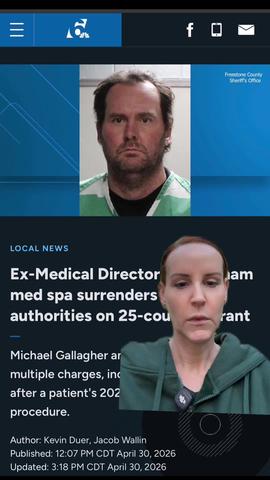
Jennifer's Law: An Update on the Tragic IV Hydration Death in Texas
May 1, 2026
Dr. Killeen breaks down the legal update to the Jennifer Cleveland case — the Texas med spa IV hydration death where a non-medical owner ordered TPN electrolytes — and the new patient-safety law passed in her name requiring qualified physicians, PAs, or NPs to order and administer all IV therapy.