Is Mold Growing in Saline Implants and Going Into Your Body?
Is mold in a saline implant a reason not to get breast implants? No. It is exceedingly rare, and the scary brown chunks you see online are almost always Betadine, not mold. Mold and bacteria cannot cross the implant shell, so even if present, it is trapped and not spreading through your body. Women deserve evidence, not fear-mongering.
Is Mold Growing in Saline Implants and Going Into Your Body?
There's a video going around with a scary claim: that mold is growing inside saline breast implants, leaking into your body, and that this is why you should never get implants. It usually comes with a photo of an explanted implant full of brown chunky sediment that looks genuinely alarming.
So let's do what I always think we should do when something scary shows up on social media: go back to the evidence. I'm going to walk through exactly what the literature says about mold in saline implants, what that brown stuff actually is, and whether any of this is a real reason to avoid breast implants.
Can Mold Be Inside a Saline Implant? What the Literature Says
First, the honest answer: yes, it's possible — but it is exceptionally rare.
- There is a very, very small handful of case reports in the medical literature of mold being found in the lumen (the fluid-filled inside) of saline implants.
- There are also studies that swabbed random implants as they came out, and they never found it.
So we're talking about a true rarity here, not something that happens to any meaningful percentage of implant patients. A handful of case reports across the entire literature is the definition of an exceedingly uncommon complication.
It's also worth knowing: you cannot diagnose mold in an implant just by looking at it. The only way to actually confirm it is to take a sample in the OR at the time of removal and send it to the lab. Visual appearance alone does not tell you what you're looking at — which matters a lot for the next part.
What Mold Actually Looks Like (Hint: Not Brown Chunks)
Here's the part that breaks the viral claim. In all of the case reports of mold in saline implants, the mold appeared as yellowish-green or black sediment.
It did not look like the brownish chunks you see in the scary videos.
So when someone shows you an implant full of brown sediment and says "that's mold" — that doesn't match what mold in an implant has actually looked like in the documented cases. Which raises the obvious question: what is that brown stuff?
The Brown Chunks Are Almost Always Betadine
In my own experience, that brown chunky material is usually Betadine.
Betadine is a surgical antiseptic soap we use around breast implants all the time. It's well accepted and completely allowed. And for many years, because capsular contracture was a bigger problem than it is today and we didn't fully understand why it happened, it was common for surgeons to put Betadine inside the saline implant itself.
When Betadine sits inside a saline implant over time, it does exactly what you see in those videos: it sticks together and forms little brown chunks. And if a surgeon also added steroid to the fill, you can get a white, milky, caramel-looking material mixed in.
I've personally removed many implants that look exactly like this over my career. It is genuinely gross to look at. But here's the key point:
Gross isn't mold. An implant full of brown Betadine sediment is not an implant full of mold.
Even If Mold Were Inside, It Can't Travel Through Your Body
This is the claim that worries people most — the idea that mold inside the implant is seeping out into your bloodstream and making you sick. So let's address it directly, because it's been actually tested.
Mold and bacteria cannot pass through the implant shell. Researchers have tested whether these organisms can move in and out across the shell, and they can't:
- Once something is in, it stays in. It cannot diffuse back out through the shell.
- Nutrients (small molecules) can diffuse across the shell, which is how something inside could theoretically stay alive — but the mold itself is physically trapped.
So even in the rare case where mold did get inside an implant, it is not getting throughout your body. It's contained. This is also true of the fungal agents people worry about with contracture — they're exceedingly rare, the capsule your body forms around the implant walls them off, and any symptoms are local, not body-wide.
So How Does Mold Get In There at All?
If it can't cross the shell, how does it ever end up inside? The answer comes down to how the implant is filled — and it points to a technique problem, not an implant problem.
Silicone implants come pre-filled. Saline implants come empty, and we fill them in the OR. The right way to do this is with a closed system:
- Tubing connects the implant to an IV bag of sterile saline
- You pull back on a syringe to draw fluid from the bag, then push it into the implant
- Nothing is ever open to the air — no opening for contamination to get in
The problem is that not everyone uses a closed system, because doing it another way is a little bit cheaper. And not using a closed system is typically how mold gets into an implant in the first place. This is the same category of meticulous-technique issue as how we prevent implant infection and biofilm in the OR — it's about how carefully the operation is done.
So Is This a Reason Not to Get Implants?
Here's my bottom line on the original claim:
- Is mold in a saline implant a reason not to get breast implants? No. It is an exceedingly rare complication, and the scary brown-chunk photos are almost always Betadine, not mold.
- But it might be a reason not to go to a particular surgeon. If mold genuinely did end up in someone's implant, that points to a technical error in the OR — most likely not using a closed filling system — and not to something inherent or common with implants.
This is exactly the kind of fear-based content I find frustrating, and it fits a pattern of self-promotion through fear-mongering that I see far too often. Women deserve accurate, evidence-based information when making decisions about their bodies. They don't deserve fear-mongering, and they don't deserve misinformation. They deserve to know what the data actually says and what the true risks and benefits are.
And one more thing, since people always wonder about motives: I put breast implants in, but I also take a lot of them out — and explant is the more expensive surgery. So if I were driven by money, it would actually benefit me to scare you out of your implants. I'm not doing that. I'm telling you what the evidence shows, because that's what you deserve.
The Bottom Line
- Mold inside a saline implant is real but exceptionally rare — only a tiny handful of case reports exist, and random-implant studies found none.
- The scary brown chunks in viral videos are almost always Betadine (sometimes with steroid), not mold. Real mold appeared yellow-green or black, and you can't diagnose it by sight — it takes a lab sample.
- Mold and bacteria can't cross the implant shell, so even if present, it's trapped and not spreading through your body.
- When it does happen, it's a technical error — usually skipping the closed filling system — not a reason to avoid implants altogether.
Scary social media posts deserve a calm look at the actual evidence. That's all this ever needed.
Your Journey to Renewed Confidence

Transform Your Life
Every person deserves to feel comfortable and confident in their own body. Our procedures aren't just about physical change. They're about reclaiming your life, your comfort, and your self-assurance.
Dr. Killeen and her team support you every step of the way, from your first consultation through recovery.
Take the first step toward the life you deserve.
Schedule Your ConsultationTransform Your Life
Every person deserves to feel comfortable and confident in their own body. Our procedures aren't just about physical change. They're about reclaiming your life, your comfort, and your self-assurance.
Dr. Killeen and her team support you every step of the way, from your first consultation through recovery.
Take the first step toward the life you deserve.
Schedule Your ConsultationRelated Articles

Implant Reconstruction Myths: Mold, Mammograms, and Fear Tactics
September 10, 2026
A creator who works at a breast center said she would never have implant reconstruction. Dr. Killeen separates the true part (no surgery is complication-free and every reconstruction ages) from the false: you do not get mammograms of a reconstructed breast after a mastectomy, mold around implants is rare, was local rather than systemic, and was a saline implant finding while reconstruction uses silicone, and mammography techs do not resent imaging women with implants. Plus what complication inflation is and why it works.

My Plastic Surgery Pet Peeve: Self-Promotion Through Fear-Mongering and Old Implant Photos
April 30, 2026
Dr. Killeen takes on the trend of plastic surgeons misrepresenting valid techniques as dangerous to drive personal practice volume — and the misleading use of decades-old "dinosaur egg" implant photos as if they represent the reality of modern implant care in 2026.
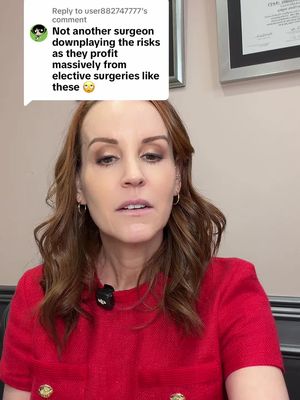
Follow the Money: Who Actually Profits From Implant Fear-Mongering
June 24, 2026
Dr. Killeen responds to the accusation that surgeons downplay explant risks to keep selling implants — by following the money. In the US, removing implants pays a plastic surgeon two to three times more than placing them, so the financial incentive runs toward explant. She breaks down how the cash-only "explant experts" operate, and why anyone truly seeing documented mold infections would report them, not post fear-bait at vulnerable women on social media.