Breast Reconstruction With Implants When You Have EDS
With EDS it is very common to have trouble with your tissue supporting the implant. I like meshes more than dermal matrix for these patients, and specifically meshes that leave behind a little firmer scar tissue as they dissolve, not ones that go away altogether, because you need that extra support.
Breast Reconstruction With Implants When You Have EDS
A patient with Ehlers-Danlos syndrome (EDS) asked whether implant-based breast reconstruction is even possible for her.
Yes, absolutely. I've done mastectomy reconstructions on patients with Ehlers-Danlos. We just make some minor adjustments to the plan. Here's what changes.
The Core Problem: Tissue Support
The commenter was exactly right about the central issue: with EDS, it's very common to have trouble with your tissue supporting the implant.
That's the whole challenge in one sentence. Implant reconstruction depends on the surrounding soft tissue to hold the implant where you put it, and EDS tissue is inherently more lax and less able to do that job. So the adjustments I make are all aimed at adding support the tissue can't supply on its own.
Adjustment 1: Mesh Over Dermal Matrix
Most of us routinely use surgical scaffolding to help support the implant in reconstruction. But for EDS patients specifically, my preference shifts:
I like meshes more than dermal matrix for my EDS patients.
And I get more specific than that. I want meshes that leave behind a little firmer scar tissue as they dissolve, rather than ones that simply go away altogether.
The reasoning is straightforward: when your own tissue can't provide adequate support, you want the scaffold to leave something behind that does. A product that fully disappears returns you to relying on the tissue that was the problem in the first place. (This is also why scaffold choice changes how much things settle.)
Adjustment 2: Stage Your Upsizes
Here's something I've learned specifically from my EDS patients:
They don't tolerate implant upsizes very well.
So if you want a larger implant than what you're starting with, it's often better to do that in stages rather than all at once at the time of the mastectomy, which is how I'd normally approach it.
Asking lax tissue to accommodate a significant volume jump in a single step tends not to go well. Building up gradually gives the tissue time to adapt to each increment.
What to Expect: Scars and Revisions
Two honest expectation-setters.
Widened, atrophic scars are more common in my EDS patients. That's a known feature of how EDS tissue heals, and it's worth planning your scar care accordingly from the start rather than reacting to it later.
And overall: all of these issues are manageable, but together they mean a potentially higher risk of revision. That isn't a reason to avoid reconstruction. It's a reason to go in knowing it, so a second stage feels like part of the plan rather than a failure.
The Bottom Line
- Yes, you can absolutely have implant-based reconstruction with EDS. I've done many.
- The core issue is that EDS tissue struggles to support an implant, so every adjustment adds support.
- I prefer mesh over dermal matrix, specifically meshes that leave firmer scar tissue behind as they dissolve rather than disappearing entirely.
- Stage your upsizes instead of doing a large jump at the time of mastectomy.
- Expect widened atrophic scars more often, and a higher revision risk overall.
None of this rules you out. It just means your surgeon should be adjusting the plan for your tissue, not running the standard playbook. If you have EDS and you're heading toward reconstruction, ask your surgeon directly what they change for connective tissue disorders. The answer will tell you a lot.
Your Journey to Renewed Confidence
Transform Your Life
Every person deserves to feel comfortable and confident in their own body. Our procedures aren't just about physical change. They're about reclaiming your life, your comfort, and your self-assurance.
Dr. Killeen and her team support you every step of the way, from your first consultation through recovery.
Take the first step toward the life you deserve.
Schedule Your ConsultationTransform Your Life
Every person deserves to feel comfortable and confident in their own body. Our procedures aren't just about physical change. They're about reclaiming your life, your comfort, and your self-assurance.
Dr. Killeen and her team support you every step of the way, from your first consultation through recovery.
Take the first step toward the life you deserve.
Schedule Your ConsultationRelated Articles
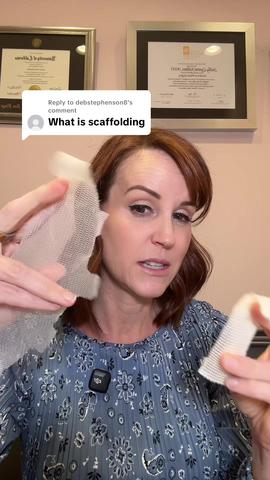
What Is "Scaffolding" in Breast Surgery? Dermal Matrix, Mesh, and What They Actually Do
August 21, 2025
Dr. Killeen explains what surgeons mean by "scaffolding" in breast surgery — including dermal matrix products like AlloDerm and Strattice, dissolvable meshes like TIGR and Galaflex, and why this is fundamentally different from the vaginal mesh products you've seen in scary commercials.
Mesh vs. Dermal Matrix in Breast Reconstruction: Do You Settle the Same Way?
May 15, 2025
Dr. Killeen explains how mesh and dermal matrix (ADM) differ in breast reconstruction: dermal matrix stretches and settles (about 20%), while mesh largely keeps things where the surgeon places them, making precise placement more important. She covers why fast- vs slow-dissolving meshes change long-term support and settling, the questions to ask your surgeon, and the normal tightness-to-softening timeline.
Breast Surgery Scaffolds, Ranked: My Favorites, My Least Favorites, and Why
July 13, 2026
Dr. Killeen gives a candid, product-by-product guide to the scaffolds used in breast surgery — acellular dermal matrix (AlloDerm, FlexHD, Cortiva), the pig version Strattice she dislikes, the off-market disaster SERI Scaffold, and the dissolvable meshes GalaFLEX (her favorite, for its anti-inflammatory and anti-microbial peptides that reduce seromas and help with contracture), TIGR Matrix (close second), plus DuraSorb and OviTex, which she likes least. She also explains how she decides whether to use one at all. Note: all are off-label in the breast.