What Is "Scaffolding" in Breast Surgery? Dermal Matrix, Mesh, and What They Actually Do
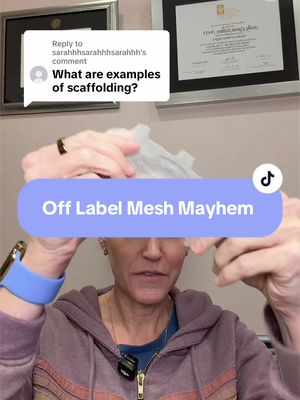
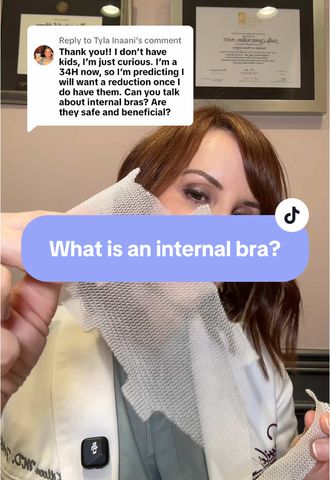
When I talk about mesh in breast surgery, people panic thinking of the vaginal mesh in scary commercials. This is not that. The meshes we use dissolve, leaving behind firmer collagen than you would have made — a collagen hammock supporting the breast or implant.
What Is "Scaffolding" in Breast Surgery? Dermal Matrix, Mesh, and What They Actually Do
A really good question came up about what surgeons mean when we talk about using "scaffolding" in breast surgery — and it's worth a clear, plain-English walk-through because there's a lot of confusion (and some unnecessary panic) about these materials online.
Let me break down what scaffolding actually is, the main types we use, and why this is not the same as the vaginal mesh products you've seen in scary commercials.
What "Scaffolding" Actually Means
In breast surgery, scaffolding refers to a piece of material that we use during the operation to provide additional structural support beyond what your own tissue can offer.
We use scaffolding to support:
- The breast itself — for example, holding up the breast tissue after a lift or reduction
- An implant — supporting the implant pocket so the implant stays where we want it to be
This is used in both cosmetic breast surgery and breast reconstruction. It's extremely common, and most patients having complex breast operations will have some form of scaffolding used during their surgery.
The Two Main Categories
Most surgeons today use one of two types of scaffolding (or, in some cases, both):
1. Dermal Matrix Products
Dermal matrix is processed dermis — the lower, stronger layer of skin — taken from a biological source:
- Human-derived dermal matrix (e.g., AlloDerm)
- Porcine (pig)-derived dermal matrix (e.g., Strattice)
The cellular components are removed during processing, leaving behind a sterile collagen scaffold. When we place it during surgery, your own body integrates with it over time — your cells grow into and through the matrix, eventually leaving a tissue layer that's essentially yours but reinforced.
2. Mesh — But Not the Mesh You're Thinking Of
When I mention mesh, patients often get panicky and think I'm talking about the vaginal mesh that's been the subject of so many scary commercials and lawsuits.
This is not that. Vaginal mesh products were permanent, non-absorbable, and produced significant complications when placed in certain anatomic areas.
In modern breast surgery, no one I know of uses permanent mesh. The meshes we use are all dissolvable / absorbable, and they work very differently.
How Dissolvable Mesh Actually Works
The dissolvable meshes:
- Get placed surgically to provide initial support
- Dissolve over weeks to months
- As they dissolve, your body forms new collagen in their place
- That replacement collagen is firmer than collagen you would have made on your own
- The end result: a "collagen hammock" of your own tissue holding up the breast or implant
So you don't end up with a permanent foreign body sitting inside you. You end up with your own reinforced tissue.
The Specific Mesh Products
A few you may hear your surgeon mention:
TIGR Matrix Surgical Mesh
- A fully resorbable synthetic mesh
- Provides strong initial support
- Slowly dissolves over roughly 3 years
- Leaves behind firm, native collagen tissue
Galaflex (Poly-4-hydroxybutyrate, or P4HB)
- Another fully resorbable synthetic mesh
- Similar overall concept to TIGR — strong initial support, gradual replacement with native collagen
- Slightly different absorption profile
OviTex (Sheep-Derived)
There's also a less commonly used product made from sheep rumen (ovine tissue) — which sounds strange when you first hear it but is a reasonable biological scaffold for soft tissue support.
There are other niche products in this space too. The category is growing as the demand for dissolvable, biologically-friendly scaffolds expands.
When and Why We Use Scaffolding
Scaffolding gets used for two broad purposes:
1. To Prevent Problems
In situations where we're placing an implant in a tissue envelope that might not support it well long-term, we use scaffolding proactively to:
- Reinforce a thin tissue envelope
- Provide support to the inframammary fold so the implant doesn't bottom out
- Add coverage in over-the-muscle reconstruction to help with implant edge visibility and contour
- Support the pectoralis muscle in select augmentation techniques
2. To Solve Problems
We also use scaffolding to fix problems that have already happened, like:
- Implant that has bottomed out — mesh or dermal matrix can rebuild the lower pole support
- Implants that have drifted into the armpits — scaffolding can reinforce the lateral pocket
- Severe capsular contracture — sometimes mesh helps after capsule release
- Asymmetry from prior surgery — adding support to the problem side
In revision surgery, scaffolding can be the difference between a stable, lasting fix and a recurrence of the original problem.
The FDA Approval Question (And Why It Comes Up)
Someone always asks about this in the comments, so let me address it directly.
None of these scaffolding products are specifically FDA-approved for use in the breast. Pretty much all of them were approved by the FDA for a general soft tissue indication (hernia repair, abdominal wall reconstruction, etc.), not specifically for breast use.
So when we use them in the breast, we're using them off-label.
A few important context points:
- Off-label use is legal, common, and well-established in medicine. About 20% of all prescriptions in the U.S. are off-label.
- There are plenty of published studies on the use of these products in breast surgery
- These products are used routinely by plastic surgeons across the country, and their performance in breast surgery has been studied for decades
- They are not unproven — they are simply not specifically FDA-cleared for the breast indication
This is a regulatory and labeling situation, not a safety concern. Patients sometimes hear "off-label" and panic — but this is one of those situations where the regulatory label and clinical practice are well-aligned even if the FDA paperwork hasn't caught up to the use case.
What Patients Should Know
If your surgeon mentions using scaffolding (mesh, dermal matrix, or both):
- Ask what specifically they're using (AlloDerm? TIGR? Galaflex? Strattice?)
- Ask whether it's dissolvable or biological (in breast surgery today, it should be one or the other — not permanent synthetic)
- Ask why they're recommending it for your specific case (prevention vs. solving an existing problem)
- Ask about the cost implications (some of these products are expensive and may add meaningfully to your surgical bill, especially if your case is cosmetic)
- Don't confuse this with the vaginal mesh products you've seen in commercials. Different category, different products, different anatomy.
The Bottom Line
Scaffolding in breast surgery refers to a piece of material — typically a dermal matrix (like AlloDerm or Strattice) or a dissolvable mesh (like TIGR or Galaflex) — that we use to provide extra structural support to the breast or to an implant.
These materials either integrate with your tissue (dermal matrix) or dissolve and are replaced by your own firmer collagen (mesh). They are not permanent foreign bodies, and they're fundamentally different from the vaginal mesh products that have caused legitimate concern in other contexts.
They're widely used in both cosmetic and reconstructive breast surgery to prevent problems and to fix them — and they're one of the reasons modern breast surgery delivers more stable, longer-lasting results than the breast surgery of decades past.
If your surgeon recommends scaffolding for your case, ask the specific questions above. With clear answers, this is a tool that genuinely improves outcomes.
Your Journey to Renewed Confidence

Transform Your Life
Every person deserves to feel comfortable and confident in their own body. Our procedures aren't just about physical change. They're about reclaiming your life, your comfort, and your self-assurance.
Dr. Killeen and her team support you every step of the way, from your first consultation through recovery.
Take the first step toward the life you deserve.
Schedule Your ConsultationTransform Your Life
Every person deserves to feel comfortable and confident in their own body. Our procedures aren't just about physical change. They're about reclaiming your life, your comfort, and your self-assurance.
Dr. Killeen and her team support you every step of the way, from your first consultation through recovery.
Take the first step toward the life you deserve.
Schedule Your ConsultationRelated Articles
Breast Surgery Scaffolds, Ranked: My Favorites, My Least Favorites, and Why
July 13, 2026
Dr. Killeen gives a candid, product-by-product guide to the scaffolds used in breast surgery — acellular dermal matrix (AlloDerm, FlexHD, Cortiva), the pig version Strattice she dislikes, the off-market disaster SERI Scaffold, and the dissolvable meshes GalaFLEX (her favorite, for its anti-inflammatory and anti-microbial peptides that reduce seromas and help with contracture), TIGR Matrix (close second), plus DuraSorb and OviTex, which she likes least. She also explains how she decides whether to use one at all. Note: all are off-label in the breast.
What Is an Internal Bra? (And Why I Use Surgical Scaffolding)
May 8, 2025
Dr. Killeen explains what an internal bra is — added internal support built into a breast lift, reduction, or augmentation to hold things up like a bra. She covers the many ways to make one (stitches, fascia, skin, tucking under the muscle) and her favorite, surgical scaffolding with dissolving products like TIGR Matrix and GalaFLEX that leave supportive collagen behind. She also explains why these products are used off-label in the breast and why that deserves a conversation.
Motiva Implants for Breast Reconstruction: Why They're Still Off-Label
November 7, 2025
Dr. Killeen explains why Motiva implants are currently off-label for breast reconstruction in the US, what the FDA approval timeline looks like, and the real practical limitation patients should know about — the current size ceiling of 625 cc.