Does Insurance Cover Capsular Contracture Surgery? More Often Than You Think.
Anytime this comes up in doctor groups, non-plastic-surgeon physicians chime in saying capsular contracture surgery is absolutely not covered for cosmetic implants. That is not true. Many insurers will cover the removal and capsulectomy even for cosmetic implants. It's always worth asking.
Does Insurance Cover Capsular Contracture Surgery? More Often Than You Think — Here's the Real Answer.
A great question came in about insurance coverage for capsular contracture surgery. There's a lot of misinformation in this space — even from non-plastic-surgeon physicians who routinely tell patients incorrect things — so I want to lay out exactly how this actually works.
Short version: yes, capsular contracture is often covered by insurance — even sometimes for cosmetically placed implants. It's always worth asking.
Let me walk through the four main scenarios.
Why This Confuses Everyone
In doctor groups online, every time this question comes up, non-plastic-surgeon physicians chime in saying that capsular contracture surgery is "absolutely not covered" if the implants were placed cosmetically.
That is not true. It makes me twitchy every time I see it, because patients are getting wrong information from physicians who don't do this surgery and don't deal with the insurance side of it.
The reality is more nuanced — and the answer depends on three factors:
- Why the implants were originally placed (reconstruction vs. cosmetic)
- What grade the contracture is (Baker 2, 3, or 4)
- What your specific insurance plan covers
Let me walk through each scenario.
Scenario 1: Reconstructive Implants (Best-Case Coverage)
If your implants were placed for breast cancer reconstruction or BRCA-related prophylactic mastectomy reconstruction, you're in the best-case scenario.
For these patients, insurance typically covers:
- Implant removal
- Capsulectomy (capsule removal)
- Implant replacement with a new implant
- Often even scaffolding (mesh or dermal matrix)
This is because under the Women's Health and Cancer Rights Act (WHCRA), insurance is required to cover complications of breast cancer reconstruction. Capsular contracture qualifies.
If you're a reconstruction patient dealing with contracture, expect coverage, and have your surgeon's office work with insurance to get pre-authorization.
Scenario 2: Other Reconstructive Indications (Coverage Varies)
Some patients have implants placed for other reconstructive reasons that aren't breast cancer specifically:
- Tuberous breast deformity correction
- Benign mass removal with reconstruction
- Other congenital chest wall asymmetries
Insurance treatment of these is inconsistent:
- Sometimes the full procedure is covered like cancer reconstruction
- Sometimes insurers exclude these from "reconstruction" coverage benefits
- Plan language varies enormously
In situations where the full procedure isn't covered, insurance will often still cover:
- Implant removal
- Capsulectomy
But they won't cover what you do afterward to reconstruct the breast — the implant replacement, scaffolding, fat grafting, or lift — that becomes your out-of-pocket portion.
Scenario 3: Cosmetic Implants With Capsular Contracture
This is where the misinformation runs rampant. Cosmetic implant patients are not automatically denied coverage for contracture surgery.
What's Often Covered
Many insurance plans will cover at least part of contracture surgery in cosmetically-placed implants:
- Implant removal
- Capsulectomy
This isn't universal — but it is common. Plenty of plans recognize capsular contracture as a legitimate medical complication regardless of why the implant was originally placed.
What's Not Covered
Even when insurance covers the implant removal and capsulectomy portions:
- Implant replacement is not covered — that's considered cosmetic
- Scaffolding is not covered
- Breast lift to reshape after explant is not covered
- Fat grafting is not covered
So if you want to replace the implants or reshape the breast, those portions are your out-of-pocket cost. But the medically necessary part (getting the contracture tissue out) is often covered.
Plan-Specific Riders
Some insurance plans have specific riders that exclude any coverage for cosmetic implant complications. These plans will say in their language: "We do not cover complications related to implants placed for cosmetic reasons."
If your plan has that rider, you're out of luck for coverage. But the rider is plan-specific — not universal across insurers. You have to actually check your plan.
This is why I push back hard on the "absolutely not covered" claim: it's not what I see in practice. I do contracture surgery covered by insurance for cosmetic implant patients all the time.
Scenario 4: The Grade of the Contracture Matters
Beyond the reconstruction vs. cosmetic question, the grade of the contracture matters for coverage:
Baker 1 — No Coverage
- Soft, normal-appearing breast
- Not technically a contracture
- Nothing to cover
Baker 2 — Usually Not Covered
- Slight firmness, no visible distortion
- Some insurers consider this not severe enough to qualify as a medical necessity
- Typically not covered for either reconstructive or cosmetic patients
Baker 3 — Usually Covered
- Visible firmness and distortion
- Often considered medically necessary to address
- Typically covered for both reconstructive and cosmetic patients, plan permitting
Baker 4 — Almost Always Covered
- Painful, distorted, hard breast
- The pain criterion is what insurers look for
- Almost always covered when meeting plan eligibility
So if your contracture is mild (Baker 2 with no symptoms), insurance is unlikely to cover surgery even if you have reconstruction-grade benefits. The contracture needs to be clinically significant (Baker 3 or 4) to qualify.
The "Always Ask" Rule
Here's my biggest practical takeaway:
Always have your surgeon's office submit for pre-authorization, even if you've been told "no" before. Plans vary. Documentation matters. Approvals happen.
In my practice:
- I have a billing team that submits insurance claims for these surgeries
- They handle pre-authorizations, appeals, and documentation
- The approval rate for medically appropriate contracture surgery is much higher than patients expect, even in cosmetic implant cases
If your surgeon's office tells you "insurance won't cover this, just pay cash" — without actually trying to submit — that's worth pushing back on. It may be true, but at minimum, ask them to try the pre-authorization.
For more on how plastic surgeons handle insurance generally, see my prior post.
What Plastic Surgeons Should Know (But Some Don't)
I want to circle back to the misinformation thing because it genuinely matters.
When non-plastic-surgeon physicians on doctor forums confidently tell patients "capsular contracture surgery is not covered for cosmetic implants," they're:
- Wrong about what insurers actually do
- Steering patients away from pursuing legitimate coverage
- Adding to the cost burden on patients who didn't need to pay out of pocket
If you're a plastic surgeon reading this, please push back when you see this in the wild. And if you're a patient: the doctor in the forum is probably wrong. Ask your plastic surgeon's billing team to actually try.
Putting It All Together
| Patient Profile | What's Typically Covered |
|---|---|
| Reconstruction (cancer/BRCA), Baker 3-4 | Full procedure: removal, capsulectomy, replacement, often scaffolding |
| Reconstruction (tuberous/benign), Baker 3-4 | Variable — often removal + capsulectomy only |
| Cosmetic, Baker 3-4 | Often removal + capsulectomy only (not replacement) |
| Any indication, Baker 1-2 | Usually no coverage — not severe enough |
| Any plan with cosmetic exclusion rider | No coverage regardless of grade |
What to Ask Your Insurance and Surgeon's Office
Practical questions to ask:
For Your Insurance Company
- "Does my plan cover capsular contracture surgery?"
- "Are there any exclusions for cosmetically-placed implants?"
- "What's the difference in coverage between Baker 3 and Baker 4?"
- "What pre-authorization documentation do you need?"
For Your Surgeon's Office
- "Will you submit for pre-authorization?"
- "Do you have a billing team experienced with this insurer?"
- "What's your typical approval rate for this kind of case?"
- "If insurance denies, will you help me appeal?"
A surgeon's office that actively engages with insurance is a meaningful value-add for a contracture revision.
The Bottom Line
Capsular contracture surgery is more often covered by insurance than you might think. The misinformation that contracture surgery is "absolutely not covered" for cosmetically-placed implants is wrong — it depends on:
- Why the implants were placed (reconstruction = better coverage)
- What grade the contracture is (Baker 3-4 = typically eligible)
- What your specific plan covers (some have cosmetic exclusion riders, many don't)
Even when only the removal and capsulectomy portions are covered (and not implant replacement, scaffolding, or lift), that's still meaningful financial relief.
Always ask. Always try. Don't let the doctor in the online forum talk you out of pursuing coverage you might actually have.
Your Journey to Renewed Confidence

Transform Your Life
Every person deserves to feel comfortable and confident in their own body. Our procedures aren't just about physical change. They're about reclaiming your life, your comfort, and your self-assurance.
Dr. Killeen and her team support you every step of the way, from your first consultation through recovery.
Take the first step toward the life you deserve.
Schedule Your ConsultationTransform Your Life
Every person deserves to feel comfortable and confident in their own body. Our procedures aren't just about physical change. They're about reclaiming your life, your comfort, and your self-assurance.
Dr. Killeen and her team support you every step of the way, from your first consultation through recovery.
Take the first step toward the life you deserve.
Schedule Your ConsultationRelated Articles
Do You Have to Remove the Capsule When You're Explanting for a Contracture?
May 26, 2026
Dr. Killeen explains when and why she removes the entire capsule during implant removal for capsular contracture, and the real trade-off: adding a capsulectomy raises the risk, mainly bleeding (hematoma), though the overall risk stays low. Plus when leaving some capsule behind is a defensible choice.
How to Actually Get Insurance to Cover Breast Implant Removal
August 11, 2025
Dr. Killeen walks through when insurance may cover breast implant removal, including ruptured silicone, severe capsular contracture, acute infection and capsule cancer, why reconstruction patients have an easier path, and why letters from your doctors and a practice that works with insurance help.
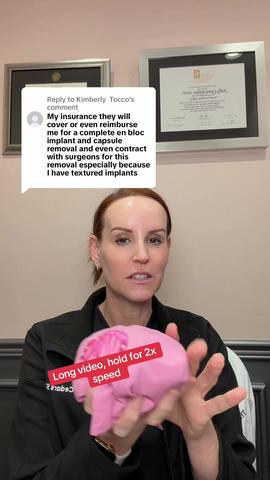
Implant Removal and Capsulectomy: Insurance, Procedure Types, and Why "En Bloc" Is Only for Capsule Cancer
May 7, 2026
Dr. Killeen breaks down the five types of implant removal and capsulectomy, why insurance often says "yes" while plastic surgeons say "cosmetic code only," and why an en bloc capsulectomy is only for a documented capsule cancer like BIA-ALCL.