A Third Patient Contracted HIV at a New Mexico Med Spa: How "Cheap" Procedures Cost Three People Their Health
The med spa charged $100 for the procedure. My disposable supply cost alone — microneedling tip plus PRP tube — is $275 per patient. They were charging less than half of just my supply cost. That math doesn't work unless you're reusing single-use equipment between patients.
A Third Patient Contracted HIV at a New Mexico Med Spa — How "Cheap" Aesthetic Procedures Cost Three People Their Health
There's been an update to a horrifying story I've been following for years: the New Mexico VIP med spa where patients contracted HIV during PRP microneedling procedures (commonly marketed as a "vampire facial"). A third patient has now been identified.
This is a case I want every patient considering aesthetic procedures to know about. It's a textbook example of what happens when untrained operators do medical procedures, and how the warning signs were visible in the pricing the entire time.
What Happened
In 2018, the New Mexico Public Health Department investigated and shut down a VIP med spa after identifying unsafe practices. They recommended that anyone who had procedures at the facility during that time period get tested for blood-borne pathogens — specifically hepatitis B, hepatitis C, and HIV.
Initial follow-up identified two patients who contracted HIV at the facility. The recent update: a third patient has now been identified as having contracted HIV at the same med spa.
This is a horrifying outcome for three individuals whose only "mistake" was choosing a med spa they didn't adequately vet.
What a "Vampire Facial" Actually Is
The procedure these patients had is most commonly known as a vampire facial — though that's a trademarked marketing term and most clinicians just call it PRP microneedling.
The procedure has two components:
1. PRP (Platelet-Rich Plasma)
- Your blood is drawn
- It's spun in a centrifuge to remove the red blood cells
- What's left is a thin yellow liquid rich in platelets and growth factors
- That's the PRP
2. Microneedling
- A device with tiny needles on a removable head is passed across the skin
- The needles rapidly move in and out, creating microscopic channels in the skin
- The PRP is applied during or after the microneedling so it absorbs into those channels
The microneedling head with the needles on it is sterile and single-use only. It comes packaged sterile, is used on one patient, and is then discarded. That's a core, non-negotiable infection control standard.
What Went Wrong (Almost Certainly)
The investigation hasn't publicly confirmed every detail of the transmission mechanism, but the pricing tells the story.
The Pricing Comparison
- The VIP med spa charged $100 per procedure
- In my own practice, the same procedure costs $1,200
- That alone is a 12× price gap
But here's the part that really matters:
- My per-patient cost for the microneedling tip and PRP tube is $275
- That's the disposable supply cost alone for a single patient
- The med spa was charging less than half of just my supply cost
That math doesn't work unless you're cutting corners somewhere. And the most plausible place to cut corners on PRP microneedling is reusing the disposable single-use needling tips between patients.
If a tip is used on Patient A who has HIV, and then reused on Patient B — that's a direct mechanism for blood-borne pathogen transmission. The needles literally carry blood from one patient into the next.
That is, in my honest opinion, the most likely explanation for how three patients contracted HIV at this specific facility.
The Legal Aftermath
Last fall, the owner of the med spa was convicted on five felony counts. She pled guilty to all five — one of which was practicing medicine without a license.
In October, she was sentenced to three and a half years in prison.
This is appropriate. But it doesn't undo what happened to the patients who contracted HIV, all of whom now live with a chronic medical condition that requires lifelong treatment.
What This Case Should Teach Every Patient
This isn't an isolated bad actor in an otherwise functional system. It's an extreme example of a pattern that exists across the aesthetic medicine market.
The "Way Cheaper" Red Flag
I want to repeat what I said about medical tourism pricing: prices dramatically below market are a red flag.
In legitimate medical practice, the costs of doing things safely — proper supplies, proper sterilization, proper training, proper supervision, proper facility — set a floor on what a procedure can cost. If someone is charging well below that floor, they're cutting corners somewhere. The corners they cut may not be visible to you as a patient — until you're the one who pays the price.
This applies to:
- PRP microneedling
- Botox and filler
- IV hydration (see the Jennifer's Law case for a fatal example)
- Laser treatments
- Surgical procedures of all kinds
The same principle applies up and down the price scale. Cheap isn't always dangerous — but dangerous is often cheap.
Credentials Matter
The owner of the New Mexico med spa was practicing medicine without a license. This is exactly what concerned me in my post about how doctors can technically practice outside their specialty, and it's in the same family of issues as the California ruling against nurse practitioners calling themselves "doctor".
Before any procedure that involves needles, lasers, prescription medications, or anything beyond skincare:
- Verify the actual clinician's credentials — name, training, license number
- Look them up on the state medical/nursing board for active license and disciplinary history
- Verify the facility — what kind of accreditation does it have?
- Ask what's single-use — and watch the staff actually take new sterile equipment from packaging
If the answer to any of these is vague, evasive, or "trust us" — leave.
Single-Use Means Single-Use
If you're ever having a procedure that involves equipment marked single-use — needles, microneedling tips, IV tubing, anything in contact with blood or sterile body cavities — you should be able to see the staff opening a new sterile package right before your procedure.
If they're bringing equipment in from another room, claiming "everything's been sterilized," or anything else that doesn't involve opening a fresh sealed package in front of you — that's worth questioning before you allow them to proceed.
What to Do If You Were a Patient at This Facility
If you had any procedure at the VIP med spa in New Mexico during 2018 — and especially a vampire facial / PRP microneedling — please:
- Get tested for hepatitis B, hepatitis C, and HIV
- Get tested again even if you tested negative previously
- Discuss the timing and exposure with an infectious disease specialist if any results are abnormal
- Inform sexual partners about your potential exposure so they can also be tested
The public health authorities are specifically encouraging this re-testing because the third patient was identified well after initial public health follow-up. Don't assume "I was tested in 2018 and was fine" means you're in the clear.
The Bigger Pattern
I want to be clear: most med spas are not like this one. The med spa industry has real legitimate operators doing safe, valuable work. But the industry also has structural vulnerabilities:
- Lower regulatory oversight than physician practices in many states
- Cash-pay model that avoids insurance credentialing scrutiny
- High patient volume with thin margins
- Aggressive marketing that often outpaces clinical infrastructure
- Multi-location chains with variable practices across sites
When these vulnerabilities stack with an operator willing to cut corners, you get cases like this one.
The Bottom Line
A third patient has contracted HIV at a New Mexico VIP med spa that was offering vampire facials for $100 when the disposable supply cost alone is around $275 per patient. The almost-certain mechanism: reuse of single-use microneedling tips between patients. The owner is now serving three and a half years for practicing medicine without a license, among other felonies.
Lessons for every aesthetic patient:
- Way cheaper than market is a red flag, not a deal
- Verify the clinician's credentials before any procedure
- Watch staff open sterile packaging in front of you for any single-use equipment
- Be suspicious of "trust us, everything is sterilized" — single-use means single-use
If you had a procedure at this New Mexico facility in 2018, please go get retested — even if you tested negative previously.
We need patients to be empowered consumers in this market, because the regulatory system isn't reliably catching this kind of operator until people are already harmed.
Your Journey to Renewed Confidence

Transform Your Life
Every person deserves to feel comfortable and confident in their own body. Our procedures aren't just about physical change. They're about reclaiming your life, your comfort, and your self-assurance.
Dr. Killeen and her team support you every step of the way, from your first consultation through recovery.
Take the first step toward the life you deserve.
Schedule Your ConsultationTransform Your Life
Every person deserves to feel comfortable and confident in their own body. Our procedures aren't just about physical change. They're about reclaiming your life, your comfort, and your self-assurance.
Dr. Killeen and her team support you every step of the way, from your first consultation through recovery.
Take the first step toward the life you deserve.
Schedule Your ConsultationRelated Articles
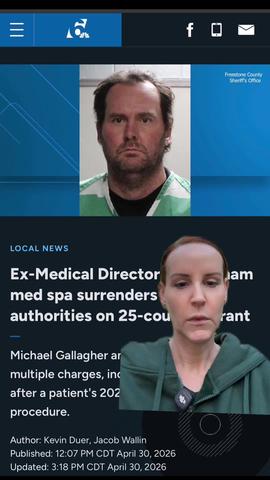
Jennifer's Law: An Update on the Tragic IV Hydration Death in Texas
May 1, 2026
Dr. Killeen breaks down the legal update to the Jennifer Cleveland case — the Texas med spa IV hydration death where a non-medical owner ordered TPN electrolytes — and the new patient-safety law passed in her name requiring qualified physicians, PAs, or NPs to order and administer all IV therapy.
How Can a Doctor Legally Practice Outside Their Specialty? And Why Isn't the Medical Board Stopping It?
July 22, 2025
Dr. Killeen explains how a medical license technically entitles a physician to practice any kind of medicine they want — and why state medical boards don't typically intervene. Plus why the regulatory trend is moving toward less restriction, not more, and what patients can do to verify their own surgeons.
The Red Flag: A Surgeon Too Rigid to Change Their Mind
March 10, 2025
One of the biggest red flags in a surgical consultation is a surgeon who is too rigid with their recommendations. Dr. Killeen uses the explant community as a case study in an evidentiary double standard: they published retrospective series with no control group, never comparing en bloc capsulectomies against patients who could not have the procedure, then fought well-done studies aggressively when researchers did the work properly. She explains why the likely motive is protecting a signature procedure, and what to listen for at your own consultation.