How Can a Doctor Legally Practice Outside Their Specialty? And Why Isn't the Medical Board Stopping It?
A medical license in most states entitles a physician to practice any kind of medicine they want — not just their specialty. The safeguards (hospital privileges, surgery center accreditation, insurance credentialing) only catch you if you're working within the system. Set up your own cash-pay office and the system doesn't see you.
How Can a Doctor Legally Practice Outside Their Specialty? And Why Isn't the Medical Board Stopping It?
A great question came in — and I don't have a fully satisfying answer, but I want to walk through how this actually works because patients deserve to understand the gaps in the system.
Short answer: in most states, a physician with a medical license can technically practice any kind of medicine they want — including specialties they weren't trained in. The medical board doesn't typically stop them. And the regulatory environment isn't moving in a direction that's going to fix this.
Here's how we got here.
What a Medical License Actually Authorizes
Every U.S. state has a medical board that issues licenses to practice medicine in that state. The general requirements:
- Complete medical school
- Complete at least 1 year of postgraduate training (an internship/residency year) in most states; 1–3+ years in others
- Pass the relevant licensing exams
- Apply for and receive a state license
That's it. That license entitles you to practice medicine in the state — full stop. It doesn't restrict you to the specialty you trained in.
What This Means in Practice
Consider this scenario:
- A doctor completes medical school
- They start a pediatrics residency
- They drop out after 2 years
- That may be enough postgraduate training to qualify for a license in their state
- They are now a fully licensed physician
And then — legally — they can do whatever they want:
- Open a plastic surgery practice (without being a plastic surgeon)
- Perform liposuction, breast augmentations, BBLs
- Start an aesthetic medicine clinic
- Inject neurotoxins and fillers
- Operate in their own facility
The license doesn't care what specialty they actually trained in.
Why This Isn't Stopped by the Real Safeguards
There are safeguards in the system that catch most of these situations:
1. Hospital Privileges
No hospital is going to allow a physician without proper specialty training to be on staff doing surgery in that specialty. Hospital privileges are one of the strongest objective filters for "this person is qualified to do this kind of work."
2. Accredited Surgery Centers
No accredited surgery center (Quad-A/AAAASF, AAAHC, hospital-affiliated) is going to credential a surgeon for procedures they aren't trained in. This is part of why the outpatient surgery center vs. hospital question usually doesn't come with a safety penalty — both are doing real credentialing.
3. Insurance Companies
Insurance companies won't work with physicians practicing outside their training. They have their own internal credentialing standards, and they're not going to reimburse a non-plastic-surgeon for breast reductions or other specialty work.
Where the Safeguards Break Down
The problem is: these safeguards only catch you if you're trying to work within the established system.
A physician practicing outside their specialty can simply work outside the system entirely:
- Build their own surgery center (non-accredited or self-accredited)
- Have their own office doing in-office procedures
- Operate as cash-pay only so insurance credentialing never comes up
- Market directly to patients via social media or paid ads
- Skip the entire layer of professional oversight that would catch them
This is where the medical board could theoretically intervene — and where it largely doesn't.
Why the Medical Board Doesn't Stop This
Honestly: they aren't structured to. State medical boards focus on:
- Direct patient harm (when there's a complaint)
- Egregious behavior (substance abuse, criminal conduct, sexual misconduct)
- Documentation of malpractice patterns
They are not particularly interested in policing the type of medicine you practice as long as the public isn't being directly harmed.
I'd argue that the public is being directly harmed by improperly trained people performing surgical procedures — but that's a slower, more diffuse harm that's hard to track in a complaint-driven system. By the time a patient gets seriously hurt and files a complaint, the practitioner has often done years of similar work.
Why It Gets Worse: The NP/PA Independent Practice Argument
Here's the part nobody likes hearing — and I get it, because nurse practitioners and physician assistants do valuable, important work and most are excellent clinicians.
But: the regulatory direction is unfortunately moving toward less restriction, not more, because of how NP/PA scope of practice has expanded.
In many states:
- Nurse practitioners can complete a much shorter training program (sometimes ~2 years post-undergrad)
- Have no postgraduate residency requirement (no equivalent of a 3–6 year specialty training)
- Can choose their specialty at will, including aesthetics
- Can have independent practice with minimal physician oversight in some states
- Can essentially operate as the medical decision-maker for an entire practice
When physicians try to push back on doctors practicing outside their training, the counter-argument they hear is essentially: "Why are you trying to limit us, when nurse practitioners can do the same things with even less training?"
And honestly, that argument has some force in front of regulators. It's harder to enforce strict specialty training requirements on physicians when other clinicians with less training are being permitted to do the same work.
So we're in a position where:
- Untrained physicians can practice outside their specialty largely unchecked
- Less-trained clinicians are pushing for more independent practice in those same areas
- The combined direction of regulation is looser, not tighter
- Patients are left to figure out the difference on their own
This connects to the California ruling about nurse practitioners calling themselves "doctor" — and to the broader misinformation patterns I've covered around clinical credentials. It's all the same underlying issue: the public can't easily tell who's actually qualified to do what.
Aesthetics: Where Most of This Plays Out
In practice, untrained physicians and unsupervised midlevel providers tend to gravitate to aesthetic medicine for one very practical reason: the money is in aesthetics.
- Insurance isn't involved, so credentialing requirements don't apply
- Patients pay cash and rarely investigate credentials carefully
- Marketing is direct-to-consumer, not gated through referrals
- The regulatory oversight is minimal compared to insurance-covered medicine
That's why we keep seeing med spa horror stories and chop-shop plastic surgery chains — and why most plastic surgeons I know are deeply frustrated about it.
What This Means for Patients
If you're shopping for any cosmetic procedure — or really any specialty procedure — the state medical license alone is not enough verification that the person doing your procedure is qualified.
What you actually need to verify:
1. Board Certification in the Relevant Specialty
For plastic surgery, that's the American Board of Plastic Surgery (ABPS) — not one of the made-up "boards" that some untrained physicians cite.
2. Hospital Privileges
Does the surgeon have hospital privileges at a reputable hospital for the procedure they're doing on you?
3. Surgery Center Accreditation
Is the facility where they're operating properly accredited by a recognized body?
4. Disciplinary History
Look up the physician on your state medical board's website. Most have public lookup tools showing licensing status and disciplinary actions.
5. Your Gut at Consultation
Does this person know what they're doing? Are they evasive about their training? Are the photos on the website actually their work? Trust your instincts.
My Honest Thoughts
I genuinely wish this were better regulated. The current system relies on:
- Most doctors doing the right thing (which they do — but a small bad-apple population can cause enormous harm)
- Hospitals and surgery centers catching unqualified physicians at the credentialing step
- Patients self-vetting their own providers
The first two work most of the time. The third one is a lot to ask of patients in a stressful, vulnerable moment.
I'd love for the state medical boards to play a more active role in ensuring physicians are practicing within their training. I don't expect that to happen soon — and the trend, frankly, is moving in the opposite direction.
The Bottom Line
A medical license entitles a physician to practice medicine in a state — not necessarily within their original specialty. The safeguards that catch most of this (hospital privileges, surgery center credentialing, insurance company credentialing) work for physicians operating within the established system, but not for those who set up their own cash-pay practices outside of it.
The trend isn't getting better, partly because expanded independent practice for midlevel providers has made it politically harder to enforce stricter training requirements on physicians.
As a patient, the license is the floor — not the ceiling. Verify board certification, hospital privileges, surgery center accreditation, and disciplinary history before any major procedure. The system isn't going to do that work for you.
Your Journey to Renewed Confidence

Transform Your Life
Every person deserves to feel comfortable and confident in their own body. Our procedures aren't just about physical change. They're about reclaiming your life, your comfort, and your self-assurance.
Dr. Killeen and her team support you every step of the way, from your first consultation through recovery.
Take the first step toward the life you deserve.
Schedule Your ConsultationTransform Your Life
Every person deserves to feel comfortable and confident in their own body. Our procedures aren't just about physical change. They're about reclaiming your life, your comfort, and your self-assurance.
Dr. Killeen and her team support you every step of the way, from your first consultation through recovery.
Take the first step toward the life you deserve.
Schedule Your ConsultationRelated Articles
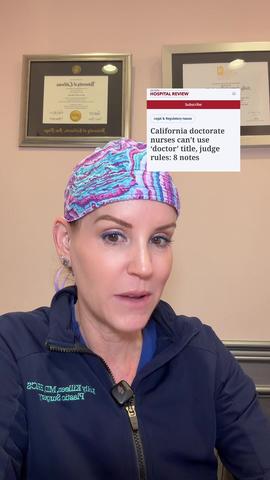
A Federal Judge Just Ruled Nurse Practitioners Can't Call Themselves "Doctor" in California
September 30, 2025
Dr. Killeen breaks down the new federal ruling against three California nurse practitioners who sued for the right to advertise themselves as "doctor" without clarification, the 39% of the public that believes a DNP is a physician, and why this is a patient safety issue rather than a turf battle.
What Happens When a Doctor Realizes They Don't Love Their Specialty?
March 19, 2025
Dr. Killeen responds to Dr. Frances Mei on something medicine rarely discusses: what happens when you are years into a specialty and realize it is not for you. She explains why residency structurally locks physicians in, why it is so hard to tell early misery from genuine mismatch, and shares the story of a surgical critical care fellow who told her mentors every year for five years that surgery was not for her and was told each time that it gets better. She also pushes back on the idea that physicians should tolerate any treatment out of gratitude for getting in.
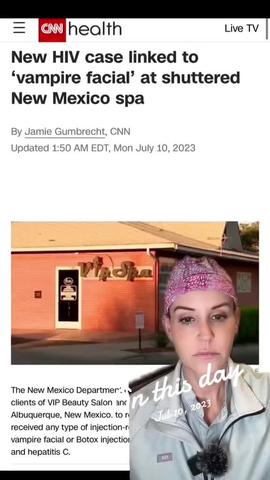
A Third Patient Contracted HIV at a New Mexico Med Spa: How "Cheap" Procedures Cost Three People Their Health
July 10, 2025
Dr. Killeen breaks down the update to the New Mexico VIP med spa case where a third patient has now been identified as contracting HIV from a "vampire facial" PRP microneedling procedure. Plus what the $100 pricing told us about the corners being cut, and how to verify safety before any aesthetic procedure.