What's the Difference Between a Plastic Surgeon and a "Cosmetic Surgeon"? It's Huge.
Cosmetic surgery is part of plastic surgery training. The only ACGME-accredited residency program that teaches cosmetic surgery is plastic surgery. Cosmetic surgeons made up their own board so they could skip the line — 12 to 18 months of fellowship instead of 6 to 9 years of residency. That tells you something about their priorities.
What's the Difference Between a Plastic Surgeon and a "Cosmetic Surgeon"? (Spoiler: It's Huge.)
This is one of the most important things every patient considering aesthetic surgery should understand: a plastic surgeon and a "cosmetic surgeon" are not the same thing. The two titles get used interchangeably in marketing, but the training behind them is dramatically different.
I want to walk through exactly what each title means, why the distinction matters for your safety, and why the "cosmetic surgery" track exists in the first place.
How Plastic Surgery Training Actually Works
Let me start with what real plastic surgery training looks like.
Step 1: Medical School
After college, plastic surgeons complete 4 years of medical school. We earn our MD (or DO) and graduate as doctors.
Step 2: Residency Through the ACGME
After medical school, doctors enter residency in their chosen specialty. Residencies are run by the ACGME (Accreditation Council for Graduate Medical Education), which sets and enforces national standards.
The ACGME is important because:
- Programs are tightly structured
- Standards are monitored and audited
- Every graduate of a given specialty has had a similar broad experience
- It ensures doctors have a consistent, comprehensive fund of knowledge when they finish
For plastic surgery specifically, residency takes:
- 6 to 9+ years of training after medical school, depending on the pathway
- Includes general surgery training in many pathways
- Includes comprehensive plastic surgery training across reconstructive, cosmetic, hand, burn, pediatric, and microsurgical work
- See my post on what plastic surgeons actually do for the full scope
Step 3: Board Certification
After completing residency, plastic surgeons sit for board examinations through the American Board of Plastic Surgery (ABPS) — one of the 24 medical specialty boards recognized by the American Board of Medical Specialties (ABMS).
The ABMS is the gold standard for board certification in medicine. ABMS boards are:
- Rigorous
- Standardized
- Independently regulated
- The only board certification most insurance companies, hospitals, and credentialing bodies recognize
A Key Point
Cosmetic surgery is part of plastic surgery training. The only ACGME-accredited residency program that teaches cosmetic surgery is plastic surgery.
That fact is essential for understanding what comes next.
How "Cosmetic Surgery" Training Works (And Why It Exists)
"Cosmetic surgery" as a separate specialty was essentially invented to bypass the plastic surgery residency track. Here's the actual structure:
Their Training Pathway
After completing a residency in a different specialty (sometimes general surgery, sometimes OB/GYN, sometimes family medicine, sometimes nothing more than a transitional year), some physicians do a cosmetic surgery "fellowship":
- Not ACGME-accredited
- Anywhere from 6 to 18 months in duration (vs. years for a real residency)
- Not standardized across programs
- Not externally regulated the way ACGME programs are
- Often run by practicing cosmetic surgeons rather than academic institutions
- Variable supervision and case volume
Their "Boards"
Instead of taking the recognized ABMS board, cosmetic surgeons take certification from a non-ABMS board — typically the "American Board of Cosmetic Surgery" (ABCS) or similar.
These boards are:
- Created by cosmetic surgeons themselves, not by independent specialty bodies
- Not recognized by the ABMS
- Not equivalent to plastic surgery board certification
- Not recognized by many hospitals for credentialing
- Not allowed to be advertised as board certification in certain states (like California) under truth-in-advertising laws
Why This Pathway Exists
If you ask: "Why would someone go this route instead of doing real plastic surgery training?" — the honest answers are:
- They didn't want to spend the time — 1-2 years vs. 6-9 years
- They couldn't get in to a plastic surgery residency — these are very competitive
- Cosmetic surgery is lucrative and cash-pay, so the financial incentive to take the shorter route is strong
In my opinion (and I'm being honest about it being an opinion): if a clinician chose this path, they're saying something about how seriously they take patient safety. Cutting years out of training to start charging cash for elective surgery is a values statement.
What Cosmetic Surgeons Often Claim (And Why It's Wrong)
There are some common talking points used by cosmetic surgeons in marketing and online debates that I want to address directly.
Claim 1: "Cosmetic surgeons focus exclusively on cosmetic work, so they're better at it"
This is one of their most popular arguments. They claim that plastic surgeons "waste their time" on reconstructive work, while cosmetic surgeons are "specialists" in aesthetics.
This shows they don't understand what reconstruction actually is.
Reconstruction is the ultimate cosmetic surgery.
When we rebuild a face after trauma, restore a breast after cancer, or repair complex tissue loss, we are making areas of the body look normal and as they should. That is fundamentally cosmetic work, layered on top of functional restoration. The aesthetic skills you build doing reconstruction — understanding tissue dynamics, scarring, proportion, symmetry, blood supply, healing — make you a better cosmetic surgeon.
A plastic surgeon who has done years of reconstructive work brings deeper aesthetic understanding to a breast augmentation than someone whose entire training was a 12-month aesthetic fellowship. The reconstructive foundation is what makes cosmetic results sophisticated.
Claim 2: "Their training is just as long as plastic surgery training"
The infographics that cosmetic surgeon organizations circulate often count years of unrelated training toward their "plastic surgery equivalent" total. So they'll add up:
- 4 years of medical school (everyone)
- 4-5 years of OB/GYN or general surgery residency (in a completely different field)
- 12-18 months of cosmetic surgery fellowship
…and present it as 9+ years of training "equivalent" to plastic surgery.
But years of OB/GYN training do not prepare you to do breast augmentation. Years of family medicine do not prepare you to do rhinoplasty. The math doesn't actually work.
A plastic surgeon's 6-9 years are spent specifically on surgical training that includes cosmetic work. The cosmetic surgeon's "equivalent" years are mostly in other specialties with no cosmetic content.
Claim 3: "We're board certified too"
Yes — but by a board they invented. The "American Board of Cosmetic Surgery" is not the same as the "American Board of Plastic Surgery." One is a recognized specialty board under the ABMS umbrella. The other is a privately-organized certification body.
States with truth-in-advertising laws (like California) prohibit advertising board certification unless it's an ABMS board, specifically because the public is being misled by these similar-sounding alternate boards. I think every state should have this law.
The Inconsistency Problem
Even within the cosmetic surgery world, training is wildly inconsistent. The American Board of Cosmetic Surgery now says they require a surgical residency for certification — but historically that wasn't the case, and there are still many cosmetic surgeons in practice today who:
- Completed only a transitional year of training (basically internship)
- Never did a full surgical residency
- Were "grandfathered" in under earlier looser standards
I did a video response to a cosmetic surgeon in Florida who literally didn't do a residency at all — she completed one transitional year and then went straight into doing cosmetic procedures.
You can't look at "cosmetic surgeon" as a title and know what training is behind it. With plastic surgeon, you can — the path is standardized.
My Opinion on Why This Route Exists
I want to be honest about how I see the cosmetic surgery track:
Cosmetic surgeons who chose this route did so because they couldn't (or didn't want to) do the real training. They wanted to skip the line and start practicing on cash-pay patients faster.
I think that says something about their priorities and their values around patient safety. My goal has always been to:
- Do all of the proper training
- Be as safe as possible for my patients
- Be as good as possible at my craft
That involves a long road. Taking the short way isn't a values-neutral choice.
There's also a related issue I've written about: how doctors can legally practice outside their specialty — and how the medical board doesn't typically stop them. The cosmetic surgery track is essentially one institutionalized version of practicing outside your specialty.
A Quick Note on Facial Plastics and Oculoplastics
Just for completeness: there are ACGME-recognized fellowships in facial plastics (after ENT residency) and oculoplastics (after ophthalmology residency). These are legitimate pathways for surgeons specializing in those specific areas.
The point I'm making isn't that only plastic surgeons can do cosmetic procedures. It's that "cosmetic surgeons" without one of these recognized pathways are operating with much less standardized training.
For face work, look for an ABMS board-certified plastic surgeon, facial plastic surgeon, or oculoplastic surgeon. For body work, board-certified plastic surgeon is the standard.
What This Means for You as a Patient
When you're shopping for a surgeon for any aesthetic procedure:
Step 1: Verify ABMS Board Certification
Use the certificationmatters.org site (ABMS's official lookup) to confirm your surgeon is board-certified by the American Board of Plastic Surgery (or facial plastics/oculoplastics for face-specific work).
Step 2: Look Up Their Specific Training
- What residency did they complete?
- Where?
- For how long?
- Did they do additional fellowships?
This is publicly available information. A real plastic surgeon will have it on their website.
Step 3: Check Hospital Privileges
Hospitals have their own credentialing — they verify training before extending privileges. If your surgeon does the same procedure at a hospital, that's another layer of verification.
Step 4: Ask Directly
If you're uncertain about a surgeon's training:
- "Are you board-certified by the American Board of Plastic Surgery?"
- "What residency did you complete?"
- "How long was your training?"
Vague answers, or evasion when asked about specific board certification, are flags.
The Bottom Line
A plastic surgeon and a "cosmetic surgeon" are not the same thing. The training behind these titles is fundamentally different:
| Plastic Surgeon | Cosmetic Surgeon |
|---|---|
| 6-9+ years of ACGME residency | 6-18 month non-ACGME fellowship |
| Trained in cosmetic + reconstructive + microsurgical + hand + burn | Trained in cosmetic only (often coming from another specialty) |
| American Board of Plastic Surgery (ABMS-recognized) | Privately-created boards (not ABMS-recognized) |
| Standardized, audited training | Inconsistent, unstandardized training |
| Can advertise as board-certified everywhere | Cannot advertise as board-certified in many states |
If you're considering any aesthetic procedure, verify ABMS board certification in plastic surgery, facial plastics, or oculoplastics. Don't take "cosmetic surgeon" at face value — ask the specific training questions, because the path that led to that title varies enormously.
Your safety depends on the training behind the title. Make sure you know which training your surgeon actually completed.
Your Journey to Renewed Confidence

Transform Your Life
Every person deserves to feel comfortable and confident in their own body. Our procedures aren't just about physical change. They're about reclaiming your life, your comfort, and your self-assurance.
Dr. Killeen and her team support you every step of the way, from your first consultation through recovery.
Take the first step toward the life you deserve.
Schedule Your ConsultationTransform Your Life
Every person deserves to feel comfortable and confident in their own body. Our procedures aren't just about physical change. They're about reclaiming your life, your comfort, and your self-assurance.
Dr. Killeen and her team support you every step of the way, from your first consultation through recovery.
Take the first step toward the life you deserve.
Schedule Your ConsultationRelated Articles

"I Learned Liposuction on YouTube": Why This Should Terrify You
May 6, 2025
Dr. Killeen responds to a provider who admitted online that she learned liposuction from YouTube, mentors, CME courses, and textbooks — with only a one-year transitional residency, no surgical training, no hospital privileges, and no malpractice insurance. Why "different paths to the same proficiency" is false, why liposuction is core to plastic surgery training, and how to make sure you are seeing a genuinely qualified expert.
A Patient Died After Surgery in a Queens House: How to Actually Vet a Surgeon
April 7, 2025
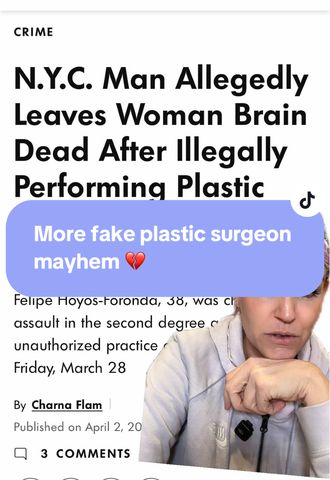
An unlicensed man performed surgery on a woman inside his Queens house, called 911 when she became unresponsive, then fled and was apprehended at JFK trying to leave the country. She could not be saved. Dr. Killeen uses the case to walk through the checks that would have prevented it: verifying state licensure and American Board of Plastic Surgery certification, confirming hospital privileges so a surgeon can follow you on transfer, checking facility accreditation, and asking where your surgery will actually be performed.
Two Ways to Become a Plastic Surgeon: Why I Did General Surgery
March 5, 2025
There are two routes into plastic surgery — the traditional path through a full general surgery residency, and the newer integrated path where you match directly into plastic surgery. Dr. Killeen explains what each one trades away, why her general surgery training gave her comfort managing critically ill patients, and why the field is moving away from her model for reasons she actually agrees with.