Stitch Abscesses After Surgery: What They Are (and Why They're Not Actually an Infection)
A stitch abscess sounds like an infection, but it usually isn't. As your body dissolves the suture, it turns into goo that looks like pus — but it's just an inflammatory wad of dissolving stitch. Remove any visible suture, spray it with hypochlorous acid, and always run it by your surgeon first.
Stitch Abscesses After Surgery: What They Are (and Why They're Not Actually an Infection)
A common post-op question came in about stitch abscesses — also called suture abscesses or "spitting sutures." These look alarming, they can show up weeks after surgery, and the name itself ("abscess") sounds like an infection. But here's the reassuring news: most of the time, they're not an infection at all.
Let me explain what's actually happening, why some people get them and others never do, and how we manage them.
What a Stitch Abscess Actually Is
When we do surgery, a lot of the stitches we use are dissolvable — they sit underneath the skin and don't need to be removed. They slowly break down and get absorbed by your body over weeks to months.
Sometimes during that process, you get a stitch abscess:
- As your body dissolves the suture, it turns into a goo that looks like pus
- But it's not pus — it's an inflammatory wad of goo from the dissolving stitch material
- It can push up through the skin and look like a pimple or small abscess
So despite the scary name, a stitch abscess is usually just your body dealing with the dissolving suture material — not a bacterial infection.
Why It Happens: Two Competing Processes
Here's the mechanism. With dissolvable stitches, two things are happening at the same time:
- Your body is dissolving the stitch (breaking it down chemically)
- Your body is trying to push foreign material up toward the skin (a natural "get this out of me" response)
These two processes are in a race:
- If the dissolving wins, the stitch breaks down quietly and you never notice
- If the pushing-it-out wins, a little wad of goo (and sometimes the actual suture) comes through the skin before it's fully dissolved — and that's your stitch abscess
Where Stitch Abscesses Tend to Show Up
There's a pattern to where these appear:
At the Knots
Stitch abscesses happen more commonly where the knot is, because:
- A knot is a little wad of extra suture material
- More material = more to dissolve
- More to dissolve = higher chance of the "push it out" process winning
Evenly Spaced Along Dermal Stitches
If your closure used a series of dermal stitches, you might see evenly spaced suture abscesses along the incision — one popping up roughly where each deep stitch sits.
At the Ends of Incisions
You'll also commonly see them:
- At the T-junction (where vertical and horizontal incisions meet, like in a breast reduction or lift)
- At the end of the horizontal incision in the crease
These are high-tension, multi-suture areas where there's more material concentrated.
Why Some People Get Them and Others Never Do
Here's something patients find frustrating but it's genuinely true: there's a genetic component to this.
- Some people never have stitch abscesses — they've had multiple surgeries with zero trouble
- Other people spit sutures every single time — no matter what we do
It's partly about how your individual body responds to foreign material. Some bodies are more aggressive about pushing sutures out than others. This isn't something you did wrong, and it isn't necessarily something your surgeon did wrong — it's partly just your biology.
What Surgeons Do to Minimize Them
While we can't change your genetics, there are technical things we do to reduce the chance of stitch abscesses:
1. Minimize Suture Burden
A lot of stitches is sometimes just a lot of stitches.
More sutures don't automatically mean a better scar. Past a certain point, extra stitches just give you more material to spit without improving how the scar looks or heals. So a thoughtful surgeon uses enough stitches to do the job — but not too many.
This connects to the broader principle of good closure technique. The goal is a clean, well-matched closure with the right amount of suture, not the maximum amount.
2. Place the Knot Deep
When tying a stitch, we want the knot placed as deep as possible for whatever type of stitch it is. A deeper knot is:
- Farther from the skin
- Less likely to push through and create a visible abscess
Knot placement is a small technical detail that makes a real difference in how often these happen.
How to Treat a Stitch Abscess
The good news: treatment is usually simple.
Step 1: Leave It Be (Mostly)
If a stitch abscess ruptures and you have a little wad of goo, the basic approach is to let it do its thing. It's your body clearing the suture material.
Step 2: Remove Visible Suture
If you can see suture material in the little wound:
- Grab it and pull it out, or
- Snip it off at the skin level
This matters because any retained stitch in that little wound will slow healing down. Getting the foreign material out lets the small wound close up.
Step 3: Hypochlorous Acid Spray
I often have my patients spray the area with a hypochlorous acid spray (Tower 28 SOS spray is one I like, but any hypochlorous acid spray works). This helps in a few ways:
- Kills bacteria in the area (preventing a true secondary infection)
- Reduces inflammation
- Increases blood flow to support healing
This is genuinely common in the plastic surgery world — we routinely ask patients to use hypochlorous acid spray on stitch abscesses. It's gentle, over-the-counter, and effective. (I'm on the medical advisory committee for Tower 28, so I'll disclose that — but hypochlorous acid as a category is a well-established, evidence-supported wound care tool regardless of brand.)
Step 4: Come In If You're Uncomfortable
If you're nervous about grabbing and removing the stitch yourself — and plenty of people are — or if it won't come out and seems stuck, just come into the office. We'll take care of it quickly and painlessly. There's no need to wrestle with it at home if it makes you anxious.
The Most Important Rule: Always Run It By Your Surgeon
Here's the thing I want every patient to hear clearly:
If you've had surgery and you think you have a stitch abscess, always run it by your surgeon first.
The reason: you want to make sure it's actually a stitch abscess and not something else. A stitch abscess looks similar to:
- A true infection (which needs antibiotics)
- A fat necrosis collection
- Other post-op issues
As a patient, we never expect you to diagnose yourself. Always call your surgeon so we can:
- Confirm the right diagnosis
- Give you the right treatment
- Rule out anything more serious
A stitch abscess is usually benign and easily managed. But the only way to know it's just a stitch abscess is to have someone with experience look at it.
When to Be More Concerned
Signs that suggest it might be more than a simple stitch abscess — and warrant a prompt call:
- Spreading redness beyond the immediate area
- Fever or chills
- Significant pain that's worsening
- Large amounts of drainage
- Multiple sites becoming red and angry at once
- Feeling generally unwell
These point toward a possible true infection rather than a benign stitch abscess, and they're worth getting evaluated quickly.
The Bottom Line
Stitch abscesses (suture abscesses) are common after surgery and usually NOT an infection. They happen when your body pushes dissolving suture material up through the skin before it's fully absorbed — creating a wad of inflammatory goo that looks like pus but isn't.
Key points:
- They're more common at knots and at the ends of incisions
- There's a genetic component — some people get them every time, others never do
- Treatment is usually simple: remove any visible suture, use a hypochlorous acid spray, and let it heal
- Surgeons minimize them by using fewer sutures and placing knots deep
- Always run it by your surgeon to confirm it's just a stitch abscess and not something else
If you develop one, don't panic — but do call your surgeon. It's almost always an easy fix, and we'd rather confirm the diagnosis than have you guess.
Your Journey to Renewed Confidence

Transform Your Life
Every person deserves to feel comfortable and confident in their own body. Our procedures aren't just about physical change. They're about reclaiming your life, your comfort, and your self-assurance.
Dr. Killeen and her team support you every step of the way, from your first consultation through recovery.
Take the first step toward the life you deserve.
Schedule Your ConsultationTransform Your Life
Every person deserves to feel comfortable and confident in their own body. Our procedures aren't just about physical change. They're about reclaiming your life, your comfort, and your self-assurance.
Dr. Killeen and her team support you every step of the way, from your first consultation through recovery.
Take the first step toward the life you deserve.
Schedule Your ConsultationRelated Articles
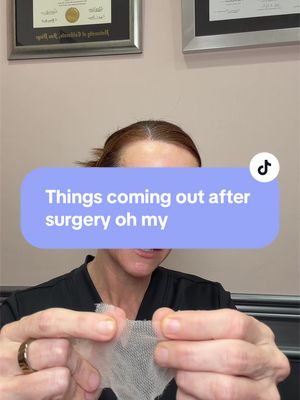
What's That Coming Out of My Incision? Stitch, Gauze, or Mesh
September 11, 2026
Patients keep posting videos of things found at their incision, convinced a piece of an instrument or dressing is coming out of them. Dr. Killeen walks through how to identify what you are actually looking at: dissolving stitch goo, a leftover black or blue non-dissolvable thread, gauze or clothing fiber stuck in dressing adhesive, or a woven piece of dissolvable mesh or a hemostatic agent like Surgicel. None of it means something went wrong.
How Surgeons Actually Prevent Implant Infection and Biofilm in the OR
October 14, 2025
Dr. Killeen walks through the specific OR techniques used to minimize the risk of infection and biofilm in breast implant surgery — from the Keller Funnel and NAC shields to irrigation solutions like hypochlorous acid and betadine, glove changes, and re-prepping the skin.

What Happens to the Fat That Doesn't Survive After a BBL or Fat Grafting?
May 3, 2025
After a BBL or fat grafting you always lose some fat (10 to 50%). Dr. Killeen explains the three fates of the fat that does not survive: your body reabsorbs it (the ideal, over weeks to months), expels it through the skin (which looks like an infection but is actually necrotic fat, not pus), or walls it off into a hard painful lump when there is too much and it is too deep to expel. Plus why an experienced surgeon can tell fat necrosis from infection, and how walled-off lumps are treated.