Warning Signs of a Plastic Surgeon Who Doesn't Evolve — and Why Patient Experience Matters
I've seen plastic surgeons telling patients with under-the-muscle implants to never use their pec muscles again. We're doing a cosmetic procedure and telling a healthy woman not to use the muscles of her own body normally? That's wild — and that's a sign we picked the wrong operation.
Warning Signs of a Plastic Surgeon Who Doesn't Evolve — and Why Patient Experience Matters
The conversation about over-the-muscle vs. under-the-muscle breast augmentation keeps coming back, and I want to add a follow-up — because there's a specific pattern I see in my own specialty that I think patients should know about before choosing a surgeon.
There is a population of plastic surgeons who:
- Do what they do, the way they've always done it
- Like their own results
- Are not willing to seriously consider other techniques that have emerged
- And — most importantly — don't ask their patients what it's actually like to live in the body they helped create
That last point is the one I want to spend real time on, because I think it's the most under-discussed factor in modern plastic surgery.
A Few Questions I'd Like to Pose to Those Surgeons
If you're a plastic surgeon who is firmly committed to dual plane or submuscular augmentation and is dismissive of over-the-muscle and Preservé-style techniques, I have a few honest questions:
1. Have You Actually Talked to Women About How It Feels?
Not just whether they're happy with the photos. Not just whether the implants look good on Instagram. But:
- How does it feel to live in your body day-to-day?
- Does the muscle movement bother you?
- Are you self-conscious about how the chest moves when you flex?
- Do you avoid certain activities or positions because of the way it feels?
- Does it ever feel weird or unnatural to you?
These are the questions that turn an "objectively beautiful" surgical result into a "this patient is actually happy with how she lives in her body" result.
2. Have You Personally Experienced Both?
I've had implants placed both under and over the muscle in my own body. I never had muscle flex deformity — by all objective measures, my under-the-muscle result was fine.
But the muscle movement made me self-conscious. As a very active person, it didn't limit my ability to exercise — but it always felt weird. After moving to over the muscle (with the pectoralis muscle repaired), I feel dramatically more normal.
You don't need to have had a breast augmentation yourself to be a good surgeon. But the conversation about what it feels like is missing if you've never asked patients to articulate it.
3. Have You Heard Yourself Tell a Patient to "Never Use Their Pecs Again"?
I've seen plastic surgeons on this app telling patients with under-the-muscle implants to just never use the pectoralis muscle again to avoid animation deformity.
Stop and think about that for a second.
We're performing a cosmetic procedure on a healthy woman and then telling her not to use the muscles of her own body normally afterward. That's wild. That's a sign that the technique we used is putting limits on the rest of her life.
If we have to ask patients to change how they live in their body to live with the result we created, we have to seriously ask whether we picked the right operation for that patient.
The Static Photo Trap
Here's where I think a lot of plastic surgery training and culture has gone sideways.
We are trained to evaluate results on static photos:
- Standing
- Arms at sides
- Front view, oblique, lateral
- Maybe a top-down photo
And our results look great in those photos. That's how we judge each other at conferences. That's how we judge ourselves.
But patients don't live in static photos. They live in motion. They move their arms. They reach overhead. They hug their kids. They lift weights. They lie on their sides. They lean forward at restaurants. Their experience of the augmentation is dynamic, and we keep evaluating it like it's a still life.
This is a real blind spot. The patient experience of "what it feels like to live in this body" is at least as important as how the chest looks at attention in a photo. Many of us — myself included — are working on shifting how we ask about that, but it's a slow culture change.
The Literature on Old vs. New Techniques
A common counter-argument from surgeons committed to dual plane is: "The data shows over-the-muscle has higher contracture rates."
I've written about this in detail elsewhere. The short version:
- Older data on over-the-muscle augmentation comes from a generation before we understood biofilm, modern OR techniques, or current implant technology
- A more recent paper compared a surgeon's dual plane results to his subfascial results, and the subfascial group had lower contracture rates
Does that mean over-the-muscle is inherently superior? Probably not. What it more likely shows is that we all get better at surgery the longer we do it, and as a field we've learned to mitigate biofilm and infection more effectively over the last 15 years.
In other words: the comparison "1995 over-the-muscle results vs. 2010 dual-plane results" doesn't actually tell you which placement is safer. It tells you that 2010-era surgery was better than 1995-era surgery — across the board.
When you compare modern over-the-muscle to modern dual plane, with current irrigation protocols, Keller Funnels, and modern implants, the complication-rate gap effectively closes. That's why so many of us in plastic surgery have transitioned back.
Three Warning Signs in a Surgeon
Here's what I'd watch for as a patient consulting for breast augmentation (or any plastic surgery procedure, honestly):
1. A Surgeon Who Does Things Only One Way
Plastic surgery is a specialty where patient anatomy varies, goals vary, and the right technique depends on both. A surgeon who only knows or only offers one approach is not customizing care to the patient — they're fitting every patient into the technique they prefer.
A great surgeon should be comfortable with multiple approaches and should be able to explain why one is best for you specifically.
2. A Surgeon Who Doesn't Evolve With the Times
Medicine evolves. What we did 15 years ago is not what we do today — and what we do today won't be exactly what we do 15 years from now. A surgeon who is doing things the same way they did them in residency, with no attention to new techniques, new implants, new data?
That's a flag. Especially in a field where the tools, materials, and techniques have meaningfully advanced.
3. A Surgeon Who Doesn't Ask About Patient Experience
This is the big one. If your surgeon:
- Only shows you photos
- Doesn't ask how previous patients felt
- Doesn't describe what daily life feels like after surgery
- Doesn't ask what your lifestyle and activities look like
…they're not factoring in the dynamic, lived experience of having implants. That's a real gap, and it shows up in real patient dissatisfaction down the line.
What Good Surgical Practice Looks Like in 2026
A modern plastic surgery practice should:
- Offer multiple placement options and explain the trade-offs of each
- Tailor the choice to the patient's tissue, lifestyle, and goals
- Stay current with literature, new techniques, and new technologies
- Genuinely ask patients what their lived experience is like — and adjust practice based on what we learn
- Be willing to say "I used to do X this way, and I've evolved"
Surgeons evolve when we listen to patients. The field as a whole improves when we collectively stop pretending we landed on the perfect answer in 2005.
The Bottom Line
If you're consulting for a breast augmentation or any breast surgery, look for a surgeon who:
- Has multiple techniques in their toolbox
- Is honest about the trade-offs
- Has evolved their practice over time
- Asks you about your lifestyle, activities, and what you want this surgery to feel like — not just look like
- Talks about how their past patients felt in addition to how they looked
A surgeon who stays static — same technique, same answers, same lack of curiosity about patient experience — is a flag. The patients living in the bodies we create deserve us to care about that experience, not just the photo.
Your Journey to Renewed Confidence

Transform Your Life
Every person deserves to feel comfortable and confident in their own body. Our procedures aren't just about physical change. They're about reclaiming your life, your comfort, and your self-assurance.
Dr. Killeen and her team support you every step of the way, from your first consultation through recovery.
Take the first step toward the life you deserve.
Schedule Your ConsultationTransform Your Life
Every person deserves to feel comfortable and confident in their own body. Our procedures aren't just about physical change. They're about reclaiming your life, your comfort, and your self-assurance.
Dr. Killeen and her team support you every step of the way, from your first consultation through recovery.
Take the first step toward the life you deserve.
Schedule Your ConsultationRelated Articles
My Thoughts on Over-the-Muscle Breast Augmentation (and How They've Changed)
September 23, 2025
Dr. Killeen explains why she's transitioned the majority of her breast augmentation and reconstruction patients to over-the-muscle placement — what changed in the data, why patients prefer it, what trade-offs (rippling, edge visibility) come with it, and how Motiva implants have helped.

Very Little Tissue and Considering a Breast Augmentation: Under or Over the Muscle?
June 15, 2026
Dr. Killeen breaks down the under-vs-over-the-muscle decision for thin breast augmentation patients — the traditional pinch test, why modern cohesive implants and fat grafting have changed the old rules, and the overlooked trade-off: thin patients see the implant more under the muscle, but they also see the muscle move more.
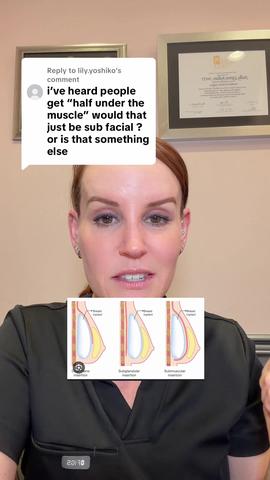
Subglandular, Submuscular, Dual Plane, Subfascial — Implant Placements Explained
October 21, 2025
Dr. Killeen breaks down the four most common breast implant placements — subglandular, submuscular, dual plane, and subfascial — what each one means anatomically, what the trade-offs are with animation deformity and biofilm, and how to think about which is right for you.