How Breast Asymmetry Is Corrected, and What to Tell Your Surgeon
Pretty much no one has perfect symmetry in their breasts.
How Breast Asymmetry Is Corrected, and What to Tell Your Surgeon
This is a complicated question, and I'm sorry, it's going to be a complicated answer: what is the best way to manage breast asymmetry?
There's no single answer, and the reason why is the most useful thing I can teach you about this.
"Asymmetry" Is Not One Thing
When you look at a breast, there are so many separate things that can cause asymmetry:
- Nipple position
- Areola size
- Where your crease sits
- How much volume you have
- The footprint of your breast, meaning how wide it is
- How projected your chest wall is
- Whether you have any chest wall tilt in either direction
Every one of those has a different fix. Some are addressed with a lift or a change in nipple position, some with areola work, some with volume, and some can't really be changed at all because they're skeletal, not breast tissue.
That's why "how do I fix my asymmetry?" can't be answered until we know which asymmetry.
What Bothers You May Not Be What I See
This is the part I want patients to really hear.
When a patient tells me they see asymmetry, it's really important that I find out what exactly is bothering them, because:
Sometimes what you see is very different than what I see.
Part of that is simple geometry. You're looking down at yourself. I'm looking at you straight on. Those two vantage points show different things, and a difference that dominates your view in the mirror may not be the difference I'd have flagged from across the exam room.
So the goal of that conversation isn't me telling you what's wrong. It's the two of us agreeing on what we're actually trying to fix.
Fat Grafting Is a Great Tool for Mild Asymmetry
For mild asymmetries, fat grafting can be an awesome way to manage the problem, and you can give yourself a little volume at the same time. It's precise, it's your own tissue, and it's well suited to filling a smaller side or smoothing a contour difference.
But again, it depends entirely on what you mean by the asymmetry. Fat won't move a crease or change a chest wall.
The Thing We Genuinely Can't Fix: Position
Here's an honest limitation that doesn't get said often enough.
When you describe asymmetries you see in different positions, that's really, really hard to operate for, because symmetry changes when you're in different positions. Your breasts move, your chest wall moves, and tissue that matches standing may not match lying down, leaning forward, or with your arms overhead.
Sometimes, even with fat grafting, even if we add an implant, no matter what we do, if you are seeing things in interesting positions, we can't operate for that.
We can make you as symmetric as possible in the positions we can actually control for. We can't make you symmetric in every position your body can get into.
Nobody Has Perfect Symmetry
It's important to consider that pretty much no one has perfect symmetry in their breasts.
Even people that think they do, I see asymmetries, because that's what I'm looking for.
Which leads to the expectation-setting part. If you're someone with a very high aesthetic standard, who notices every tiny asymmetry, then you will probably see asymmetries after surgery too. They'll just be different ones. (That's also why fixing one asymmetry can make another more noticeable, and why we sometimes operate on both sides to fix a problem on one.)
That's not a reason to avoid surgery. It's a reason to go in with healthy expectations about what "better" looks like versus "perfect."
Come to Your Consultation With a Specific Answer
The single most useful thing you can do before a consult is figure out what exactly is bugging you. Run the list:
- Is it nipple position?
- Is it areola size?
- Is it the crease?
- Is it volume?
- Is it the tilt of your breasts?
- Is it projection?
- Is it the footprint?
Name it, and your surgeon can tell you the best way to make it as symmetric as possible. Arrive with "they're uneven" and we'll spend the visit figuring out which unevenness you mean.
The Bottom Line
There's no single best way to manage breast asymmetry, because asymmetry isn't one problem. It's nipple position, areola size, crease height, volume, footprint, projection, and chest wall tilt, and each is addressed differently. (In a reduction, for example, several of these get handled at once.)
Fat grafting is an excellent tool for mild differences. Position-dependent asymmetry is the one thing we genuinely can't operate for. And no one is perfectly symmetric, so the realistic goal is meaningfully better, not flawless.
Figure out what specifically bothers you, bring that to your surgeon, and have the honest conversation about what can and can't be changed.
Your Journey to Renewed Confidence

Transform Your Life
Every person deserves to feel comfortable and confident in their own body. Our procedures aren't just about physical change. They're about reclaiming your life, your comfort, and your self-assurance.
Dr. Killeen and her team support you every step of the way, from your first consultation through recovery.
Take the first step toward the life you deserve.
Schedule Your ConsultationTransform Your Life
Every person deserves to feel comfortable and confident in their own body. Our procedures aren't just about physical change. They're about reclaiming your life, your comfort, and your self-assurance.
Dr. Killeen and her team support you every step of the way, from your first consultation through recovery.
Take the first step toward the life you deserve.
Schedule Your ConsultationRelated Articles

After a Single Mastectomy, Why the Two Sides Settle Differently
September 4, 2026
Yes, you can have surgery on the non-cancerous breast for symmetry, and it is typically covered by insurance as a symmetry procedure. Dr. Killeen explains the options for that side (nothing, a lift, a lift with a small implant, an implant, or a reduction), why the two sides usually do not look even right away (the mastectomy side has already settled while the symmetry side has never been operated on), why coming out larger is safe according to data she and her partner published, what adding fat grafting really costs you in recovery, and why the two breasts will age differently over the years.
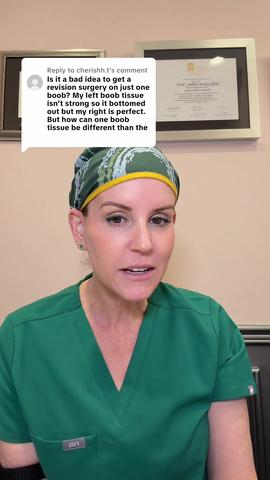
Breast Revision: Should You Fix Just One Side or Both?
October 2, 2025
Dr. Killeen breaks down the real trade-offs of operating on just the problematic breast versus both during a revision, including aging symmetry, surgical control, cost, and complication risk.

Radiated Side Firmer and Higher After Reconstruction? What Helps
July 7, 2023
After radiation, the treated side of a breast reconstruction is always a bit stiffer and sits higher than the other side. Dr. Killeen explains how to tell normal radiation stiffness from a capsular contracture, how fat grafting improves radiated tissue, and why working on both sides is often the best way to even things out.