Is Christina Applegate Being Poisoned by Her Implants?
These patients deserve high-quality, evidence-based care like any other patient. It just may not be caused by what they think it is.
Christina Applegate and Her Implants
Christina Applegate has been in the news a lot over the last few weeks. She announced a multiple sclerosis (MS) diagnosis in 2021, and last month she shared on her podcast that her doctors now say that diagnosis was wrong. Then, on the November 10 episode of her podcast MeSsy, she said she's wondered for years whether her breast implants could be "leaking and poisoning" her and causing her symptoms.
Her implants date back to her reconstruction after a 2008 breast cancer diagnosis and double mastectomy, and she's said they're overdue to be replaced.
A lot of you have asked me for an update on the newer research into breast implant illness, so this felt like the right time to do it.
A Quick Note Before We Start
I'm a board-certified plastic surgeon, and most of my practice is breast surgery. I'm going to talk about breast implant illness, how it's treated, and what's been published recently. If that kind of content upsets you, this may not be the post for you.
And one more thing: unverified anecdotes don't outweigh the published literature or expert opinion. This is a place for evidence-based information, so women can make good, informed decisions about their bodies.
What Is Breast Implant Illness?
Breast implant illness is a condition where women believe their implants are making them ill. More than 150 different symptoms have been attributed to breast implants, and we have no medical or scientific proof that implants cause them. We don't even have a mechanism that would explain how they could.
Not every patient has all of these symptoms. Most women have a small handful, and there are about 8 to 15 symptoms that come up most often.
And there are no diagnostic criteria. There is no way to diagnose a patient with breast implant illness, which is also why nobody knows the true rate of BII.
What It Doesn't Appear to Be
Over the last six or seven years, we've actually started studying these patients to figure out what is going on and why they're suffering. In brief, so far:
- It doesn't appear to be heavy metal toxicity. (Here's what the heavy metals research actually found.)
- It doesn't appear to be autoimmune.
- It doesn't appear to be caused by biofilm. (More on biofilm and BII.)
The more recent studies are starting to give us an idea of why some of these patients are suffering. Here are three.
Study 1: Somatic Symptom Disorder
The first study, published in the Aesthetic Surgery Journal in 2025, compared three groups:
- Women with implants who have breast implant illness symptoms
- Matched women with implants and no symptoms
- Women who had never had implants and were having a breast lift (mastopexy)
Over a third of the women with symptoms (34.5%) met the criteria for somatic symptom disorder (SSD). Fewer than 2% of the implant patients without symptoms did (1.9%), and about 5% of the breast lift patients (4.8%).
(Somatic symptom disorder describes distressing physical symptoms that come with persistent worry and attention focused on them, lasting at least six months. The symptoms themselves are real.)
So what does this mean? Are these patients more or less likely to get better when their implants come out? We don't know yet. There's further research ongoing, so stay tuned.
Study 2: Women Without Implants Develop the Same Symptoms
The next question researchers looked at this last year: what happens to women without implants if you just watch them over time? Do they develop these symptoms at the same rate as women with implants, or less?
It appears that women without breast implants develop symptoms at similar rates as women with them. These symptoms seem to be common in women at baseline, with or without implants.
So a certain percentage of women will develop these symptoms with time, and it may not be the implants at all.
Study 3: Social Media and the Nocebo Effect
The third piece of research is about social media's influence on breast implant illness, and it's been published in a lot of different places. Patients with BII symptoms tend to get a lot of their information from social media, and social media posts have been shown to be very inaccurate when it comes to breast implants and implant problems. (For a recent example, see the false claim that Dolly Parton died of BII.)
There also seems to be what we call a nocebo effect. If you consume content that makes you think something is going to cause negative changes or problems in your body, you are more likely to have that happen. It's kind of the opposite of the placebo effect.
I think it's important to note that women go to social media for a reason. Often they're patients who have had illness or symptoms and aren't getting the answers they want from their primary doctor, or who haven't been treated kindly by the medical community. And the social media community around breast implant illness offers them a potential cure, which is very satisfying for patients who aren't feeling well.
What This Adds Up To
- We still don't have diagnostic criteria for breast implant illness.
- We still don't know exactly what causes the symptoms. It's probably a very heterogeneous group of women.
- Women in general develop similar symptoms with or without implants with time. And it sucks.
- Social media is a bad place to get health information, especially from non-experts.
There's obviously more work to do.
Talking About Mental Health Isn't Dismissive
I know these answers sometimes aren't satisfying to patients in this community, because it can feel dismissive when someone talks about mental illness in relation to their symptoms. I think that's really unfortunate, because mental illness is a real thing and causes real symptoms.
These patients deserve high-quality, evidence-based care like any other patient. It just may not be caused by what they think it is.
The Capsule Isn't the Cause
One thing I didn't mention in the video: the capsule isn't causing these symptoms, and it doesn't need to be removed when implants come out for breast implant illness. About two-thirds of patients feel better when their implants come out, whether or not the capsule is removed. (Here's the evidence on leaving the capsule behind.)
If you think your implants are making you sick, here's how I'd approach it, starting with your primary care doctor, and what implant removal involves.
So, Is Christina Applegate Being Poisoned by Her Implants?
Is there a toxin leaching into her system? Almost certainly not. There's no published evidence to support any of that.
Can implants make health concerns you already have worse? Sometimes, yes, especially if the implants have problems. She did say her implants are old. Maybe they're ruptured. Maybe she has a capsular contracture. Who knows? It's hard to say with any celebrity story. (If your implants are getting older, here's when it makes sense to replace them.)
The Bottom Line
There's no evidence that breast implants are "poisoning" anyone. The newer research points to a few things that may be going on in some patients: symptoms that are common in women with or without implants, somatic symptom disorder, and a nocebo effect fed by inaccurate content online.
Women with breast implant illness should be treated with respect and care, and they also deserve accurate, evidence-based information. The place to find that is not in a lot of the social media groups about breast implant illness.
Your Journey to Renewed Confidence
Transform Your Life
Every person deserves to feel comfortable and confident in their own body. Our procedures aren't just about physical change. They're about reclaiming your life, your comfort, and your self-assurance.
Dr. Killeen and her team support you every step of the way, from your first consultation through recovery.
Take the first step toward the life you deserve.
Schedule Your ConsultationTransform Your Life
Every person deserves to feel comfortable and confident in their own body. Our procedures aren't just about physical change. They're about reclaiming your life, your comfort, and your self-assurance.
Dr. Killeen and her team support you every step of the way, from your first consultation through recovery.
Take the first step toward the life you deserve.
Schedule Your ConsultationRelated Articles
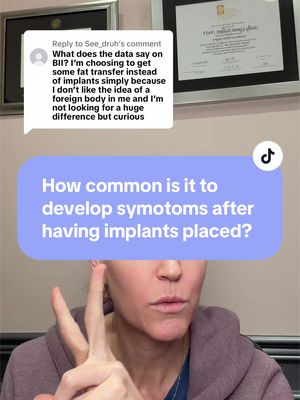
What Are the True Rates of Breast Implant Illness?
August 10, 2026
Dr. Killeen gives an honest answer to a common question: we do not know the true rate of breast implant illness, and anyone quoting a confident number is going beyond the evidence. She explains why — over 150 symptoms have been attributed to it, so it is not a definable diagnosis you can calculate a rate for — and what would actually be needed: a prospective study, defined diagnostic criteria, and a comparison group of women without implants. She also notes that retrospective comparisons have not shown a difference in the most common attributed symptoms.
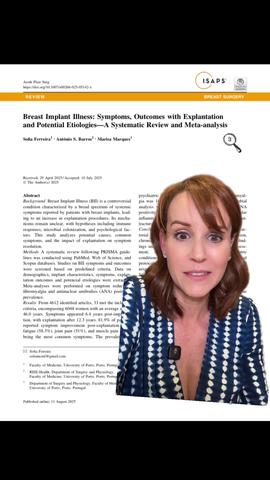
A Bad ASJ Paper on Breast Implant Illness Is Being Misused — Here's the Real Story
August 20, 2025
Dr. Killeen breaks down a recent meta-analysis in the Aesthetic Surgery Journal claiming biofilm, autoimmunity, and silicone exposure cause breast implant illness — and walks through why each of those claims falls apart when you actually examine the underlying data the paper analyzed.
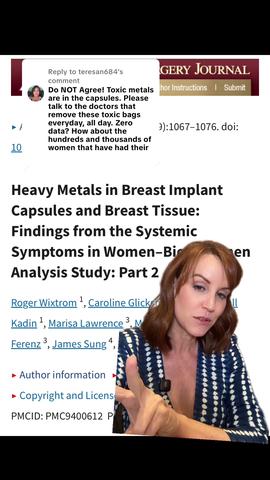
Do "Heavy Metals in Breast Implant Capsules" Cause BII? What the Research Actually Shows
August 20, 2025
Dr. Killeen responds to the common claim that heavy metals build up in breast implant capsules and require complete capsule removal — by walking through the published study showing heavy metal levels are identical in capsules of symptomatic patients, asymptomatic patients, and women who never had implants.