Is TUBA Still Done? Why I Don't Do Belly Button Breast Augmentation
If you're interested in this, I always recommend you go to the guy that does it a lot. That's not me.
Is TUBA Still Done? Why I Don't Do Belly Button Breast Augmentation
I'm replying to my own comment on a video by Dr. Darin Wolfe (The Dead Letter on TikTok). If you don't follow him, he has an absolutely fantastic account that covers forensic pathology as well as surgical pathology.
He was talking about breast implants and autopsies, and asked: is TUBA still done? So what is TUBA, and are we still doing it in plastic surgery?
What TUBA Is
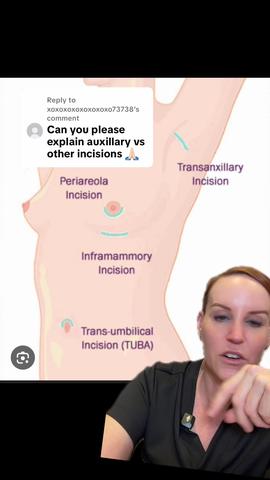
TUBA stands for transumbilical breast augmentation. It's a technique for breast augmentation where the incision is made in the belly button.
So instead of an incision under the breast, around the areola, or in the armpit (I've compared all four incision options side by side), the implant goes in through the belly button.
How It Started
When this procedure was first done, it was done blindly. Special tools were used to tunnel up from the belly button into the chest and make the space for the implant.
Usually saline implants were used, because they come empty. You roll them up into a little burrito, put them into the breast, and fill them through a long tube that you then pull out.
This was never a super popular way to do breast augmentations, for a few reasons.
Why I Don't Like the Blind Technique
When you're doing a breast augmentation, two things really matter:
- A precise pocket. You want to create a precise space for the implant, so it stays where it's supposed to be.
- Bleeding control. Managing bleeding properly helps prevent hematomas, which are a complication of course. (Here's how hematomas after breast surgery are managed.) And even a small amount of bleeding that doesn't need to be treated with surgery can lead to a capsular contracture.
A blind procedure makes both of those harder.
There was also a study at one point that looked at patients who had TUBAs, and in a pretty significant percentage of them, the implant was not where the surgeon thought it was. The surgeon thought they were placing it under the muscle, and it was actually over the muscle.
The Endoscopic Version Is Better, But Still Not Great
With improvements in technology, a lot of surgeons now do TUBA endoscopically. They put a camera up there, control bleeding, and create a more precise pocket with better tools. I do think that's an improvement.
But I still don't think it's a great method of breast augmentation, for four reasons.
1. A Long Tunnel From a Not-So-Clean Place
Even with a better way of making the space, you're still creating a long tunnel from elsewhere, starting in an area that isn't particularly known to be clean: the belly button.
2. It Limits Your Implant
Saline implants are always ideal for this approach. But saline isn't the best implant on the market, and most of us don't use saline for the majority of our augmentations.
Smaller silicone implants can, in theory, go through this incision. But larger implants and the newer cohesive implants really shouldn't, because of the risk of rupture and fracture of the silicone.
3. You Can't Do a Revision Through It
Implants are not lifetime devices. You're almost certainly going to have more surgery on them in the future.
You can't do revision surgery through a belly button incision, so you'd need an incision in the breast crease anyway.
4. It Weakens the Crease
This is the final reason I don't like TUBA. Because of the way it's done, dissecting up from the belly button and through the breast crease, you create a weak area in the crease that can't really be fixed well.
I've seen a lot of TUBAs with a really weird problem: they bottom out immediately, which isn't something we typically see with breast augmentations. And I've fixed a bunch of them. (Here's how an implant that sits too low gets fixed.)
If You Still Want a TUBA
So I'm not a fan. But some surgeons believe in it very strongly, and their whole practice is TUBAs.
If you're interested in this, I always recommend you go to the guy that does it a lot. That's not me.
Most of us don't do it, because it's just not ideal.
The Bottom Line
- TUBA (transumbilical breast augmentation) places the implant through an incision in the belly button
- It started as a blind procedure, which makes a precise pocket and good bleeding control harder. That matters for hematomas and capsular contracture, and a study found implants in the wrong plane in a significant share of patients
- The endoscopic version is an improvement, but it still means a long tunnel from the belly button, mostly saline implants, since larger and cohesive silicone implants really shouldn't go through it
- Implants aren't lifetime devices, and revisions can't be done through the belly button, so you'll need a crease incision eventually anyway
- Tunneling through the crease weakens it, and I've repaired a lot of TUBAs that bottomed out early
- If you want a TUBA anyway, see a surgeon who does a lot of them
Your Journey to Renewed Confidence

Transform Your Life
Every person deserves to feel comfortable and confident in their own body. Our procedures aren't just about physical change. They're about reclaiming your life, your comfort, and your self-assurance.
Dr. Killeen and her team support you every step of the way, from your first consultation through recovery.
Take the first step toward the life you deserve.
Schedule Your ConsultationTransform Your Life
Every person deserves to feel comfortable and confident in their own body. Our procedures aren't just about physical change. They're about reclaiming your life, your comfort, and your self-assurance.
Dr. Killeen and her team support you every step of the way, from your first consultation through recovery.
Take the first step toward the life you deserve.
Schedule Your ConsultationRelated Articles
Breast Augmentation Incisions: Transaxillary, Periareolar, Inframammary, TUBA
October 15, 2025
Dr. Killeen walks through the four common incision options for breast augmentation — armpit, around the areola, breast crease, and belly button — including the pros, cons, and infection/contracture risks of each, plus why the inframammary is her preferred choice.

Where Do You Hide Brow Lift Incisions If You Don't Have Hair?
April 15, 2025
Most brow lift techniques hide incisions in the hairline, so what do you do without hair? Dr. Killeen walks through the options: directly above the brows, inside a forehead crease, or an endoscopic brow lift with the incisions placed lower in the forehead creases instead of the hairline (a published approach with great results). She explains how the placement of your forehead wrinkles determines the best choice, and why having wrinkles is actually an advantage here.

Tethered Areola Scars: Causes and Treatment Options
January 3, 2026
Dr. Killeen explains why areola scars can become tethered after breast surgery, and walks through treatment options from cupping to fat grafting to surgical correction.